
Short answer
Homeowners who regret spray foam report the same five problems: a smell that lingers for weeks, moisture or rot behind the foam, foam that shrinks or pulls away from the framing, coverage that is thin or missed, and a messy jobsite. All five trace back to how the foam was made and installed on site, not to spray foam as a material. Each has a known cause and a known control, and each control can be checked and put in writing before the first drum is opened.
Key points
- The pattern repeats across homeowner forums, contractor review sites, a CBC Marketplace investigation, US lawsuits filed in 2013 and a UK consumer survey: odor, moisture, shrinkage, thin coverage and jobsite damage.
- Spray foam is made on your wall. Two liquids meet at the gun at a 1:1 ratio by volume; off-ratio foam smells, shrinks and cracks.
- Moisture complaints trace to the wrong foam for the climate or foam sprayed over wet wood or an active leak. Western PA is climate zone 5, where open-cell foam under a roof deck needs a vapor retarder by code.
- Shrinkage follows passes sprayed thicker than the data sheet allows, cold surfaces and framing wetter than 19% moisture content.
- Thin and missed foam is the most common problem one building scientist finds in spray-foamed houses. Depth checks and a blower-door test catch it before drywall.
Where these complaints come from
The five complaints below are the ones that come up again and again when homeowners describe a spray foam job they regret. The record is wide: homeowner threads on GreenBuildingAdvisor and the Garage Journal forum, Reddit insulation threads as reported in the press, contractor reviews on HomeAdvisor, a 2013 CBC Marketplace investigation, federal lawsuits filed the same year in seven states, and a 2025 Citizens Advice report in the UK. Nobody publishes a clean count of spray foam complaints, so the order here is how often each one recurs across those sources and how much damage it does.
The same sources carry the other half of the story. On the same Garage Journal thread that asked "Spray foam regrets?", one member summed up the forum's view: "There is a big difference between a foam job done right and one done wrong." What owners praise after a good install is in spray foam insulation reviews: what owners praise most.
1. A smell that lingers
What owners report. A fishy or sweet chemical smell that is still there weeks or months after the job, and that owners say gets worse on hot days when the sun heats the roof deck. GreenBuildingAdvisor's question-and-answer forum has many of these threads. In the worst cases families leave the house; a CBC Marketplace investigation in 2013 followed one of them.
What went wrong. One of four things. The two liquids were not mixed at the 1:1 ratio by volume the product needs (resin-rich foam comes out soft, gummy and smelly). The drums were stored outside the maker's range, typically 60 to 80°F, or were expired or contaminated. A pass was sprayed thicker than the data sheet allows, which overheats the foam. Or the space was not ventilated and people came back too soon: one homeowner describes a crew that never sealed off the attic and set up fans three days later.
The control. A GreenBuildingAdvisor contributor put it plainly: "the presence of odors long after installation is a sign of misapplication." Some smell for a few days is normal. Fresh, in-range chemicals, test shots before every start, foam watched for color and texture, and containment with exhaust fans during the spray and through the maker's re-occupancy period prevent the rest. The EPA's advice to occupants is to stay out until the manufacturer's re-occupancy procedures have been met. Spray foam smell: what's normal and what isn't covers this complaint in depth.
2. Moisture or rot behind the foam
What owners report. Fear that the roof deck will rot where nobody can see it, and worry about what a buyer's inspector will say. In one Reddit thread reported by The Cool Down, a Toronto homeowner with an attic that already had moisture problems asked whether to go ahead with closed-cell foam; one reply called it a terrible idea to foam decking that is already wet. A home inspector writing for the American Society of Home Inspectors makes the same point from the other side: a sealed roof deck makes a roof leak harder to spot.
What went wrong. Foam does not create water. It can only trap water that is already there or that the wrong design lets in. The three usual routes: open-cell foam, which passes about 30 perms per inch according to Building Science Corporation, sprayed under a roof deck in a cold climate without the vapor retarder the code requires; foam sprayed over wood that was already wet; and foam sprayed over a roof that was leaking.
The control. In climate zones 5 and up, which covers Western Pennsylvania, closed-cell foam under the roof deck does the vapor control itself: BASF WALLTITE is a Class II vapor retarder at 1.5 inches and Huntsman HEATLOK HFO High Lift from 1.875 inches, and Building Science Corporation reports it does not see the moisture problem with closed-cell foam. Every surface gets a moisture reading first; the makers want wood below 19%. Leaks are found and fixed before spraying. The deck gets photographed before it is covered, so a future buyer can see its condition. More in does spray foam trap moisture? and open-cell foam under a roof in Western PA.
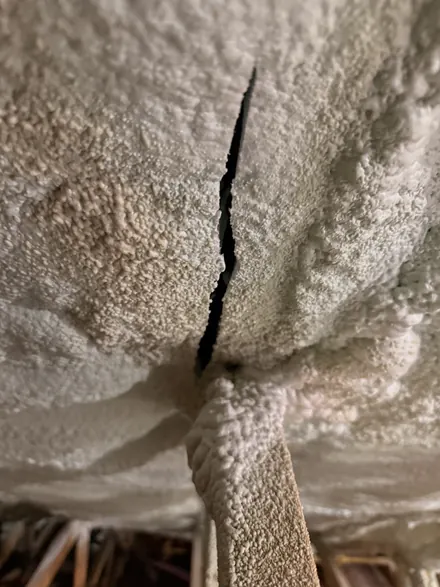
3. Foam that shrinks or pulls away
What owners report. Gaps open between the foam and the studs or rafters, sometimes within hours, sometimes after the first winter. The gap reopens the air path the foam was supposed to close.
What went wrong. A common cause is a pass sprayed too thick. Spray foam consultant Mason Knowles documented closed-cell foam sprayed more than 4 inches in one lift that came out soft in the middle and shrank severely within a day. Wood above 19% moisture and surfaces below the product's minimum temperature also weaken the bond.
The control. Passes kept within the product's own limit, with cooling time between them; surface temperature, humidity and dew point checked through the day; failed foam cut back to sound foam and resprayed in thin lifts. Spray foam pulling away from studs goes through the causes and the fix step by step.
4. Paid for foam, still drafty
What owners report. The bills barely moved, a room is still cold, or a later inspection finds thin foam and bare spots. Building scientist Allison Bailes of Energy Vanguard ranks insufficient thickness as the most common spray foam problem he sees; in one house the foam ran from zero to about 9 inches thick because it was the installer's first spray foam job.
What went wrong. No depth checks, missed leak sites, and foam put where it does nothing. Bailes describes a missed soffit that let humid air in until it condensed and dripped from the ceiling registers, and a wall foamed between two heated rooms, where the owner "paid extra and got nothing for it."
The control. Frame each cavity, then fill the middle; check depth at many points; map the boundary between heated and unheated space before spraying; test with a blower door before the drywall goes up. Still drafty after spray foam? shows where the air gets in, and how thick spray foam should be sets the targets.
5. A messy or damaged jobsite
What owners report. Foam sprayed over wiring, light fixtures, vents and HVAC dampers; overspray on things that were not covered; old insulation and trimmings left behind. One HomeAdvisor reviewer describes a crew that foamed over the dampers, leaving zero airflow, and never put back the insulation it pulled.
What went wrong. No walk-through, no masking plan, and no clear line in the contract about trimming and cleanup.
The control. A walk-through before the job, masking of everything that is staying, foam kept clear of fixtures and equipment that need clearance, and trimming and cleanup written into the price. How overspray is prevented and what happens if something is damaged answer the details.
The five at a glance
| Complaint | Usual cause | What to get in writing |
|---|---|---|
| Lingering smell | Off-ratio mix, bad drums, thick passes, no ventilation | The exact product, how the space is ventilated, and the maker's re-occupancy time |
| Moisture or rot | Wrong foam for the climate, foam over wet wood or a leak | Foam type for each surface, moisture readings before spraying, what happens to a wet area |
| Foam pulling away | Passes too thick, cold or wet framing | That the product's pass limits and temperature range are followed |
| Still drafty | Thin or missed foam, missed leak sites | Minimum thickness, and what happens if it comes up short |
| Messy jobsite | No masking plan | Masking, trimming and cleanup included in the price |
What the complaints have in common
Spray foam is manufactured on the jobsite, unlike batts, boards or loose fill. The data sheet values, the R-value, the air seal, the vapor retarder rating, describe foam processed within specification. Foam processed outside it is a different, untested material, and every complaint above starts there. That is why the material, the equipment and the person on the gun matter as much as the product name; spray foam as an add-on service and who can buy top-tier spray foam explain both.
It is also why the fix is so checkable. The 15 red flags on the contractor guide and the visual checks in how to spot bad spray foam let you confirm the controls yourself before the walls are closed.
FoamGuard writes each of these controls into its work: off-color foam is stopped, cut out and resprayed only once the cause is fixed; wet areas are held back until the cause is repaired; the quoted thickness is the minimum; trimming and cleanup are in the price; and every job ends with photos, a thermal-camera scan and the drum lot numbers in the customer's project file. Want a number for your own building? Price My Project or call (814) 208-3478.
Read next: Spray Foam Insulation Reviews: What Owners Praise Most, Checked Against the Data · How to Spot Bad Spray Foam: A Homeowner's Visual Guide · Spray Foam Pulling Away From Studs: Why It Shrinks and How It Is Fixed.
FAQ
What is the most common complaint about spray foam insulation?
A smell that lingers after the job is the complaint that recurs most in homeowner forums, and odor and health problems were central to the 2013 lawsuits. Some odor for a few days is normal; odor that lasts beyond that points to foam that was mixed or applied outside its specification.
Is spray foam insulation a bad idea?
No. The complaints trace to how the foam was installed, not to the material. Correctly made and installed foam air-seals and insulates in one step; the controls that prevent each complaint can be checked before the walls are closed.
Can spray foam rot a roof?
Foam cannot create water, but it can trap water that is already there. Rot cases involve open-cell foam without a vapor retarder in a cold climate, foam sprayed over wet wood, or a roof leak. Closed-cell foam on a dry deck, after leaks are fixed, avoids all three.
Why does spray foam pull away from the studs?
A pass sprayed thicker than the product allows, which overheats and weakens the foam, or framing that was too cold or wetter than 19% moisture. The failed foam is cut back to sound foam and resprayed in thin passes.
How do I avoid a bad spray foam job?
Ask for the exact product and its data sheet, the minimum thickness in writing, how wet areas are handled, the ventilation plan and re-occupancy time, and a project file with photos and drum lot numbers. Then check the foam before drywall.
Sources
- Garage Journal forum: Spray foam regrets? (thread, 2023)
- GreenBuildingAdvisor: Spray foam odor (Q&A)
- GreenBuildingAdvisor: Spray foam issues after a non-ventilated install (Q&A)
- GreenBuildingAdvisor: Lawsuits name makers of spray foam insulation (April 26, 2013)
- CBC News: Spray foam insulation can make some homes unlivable (Marketplace, 2013)
- Citizens Advice: A Foamidable Challenge (June 17, 2025)
- The Cool Down: Toronto homeowner's r/Insulation question on closed-cell foam
- American Society of Home Inspectors: Why I don't like spray foaming roof decks
- Building Science Corporation: BSI-016 Ping Pong Water and the Chemical Engineer (2016)
- ICC-ES ESR-2642: BASF WALLTITE spray-applied polyurethane foam insulation
- Huntsman Building Solutions: HEATLOK HFO High Lift Technical Data Sheet (rev. 11.25.24)
- Huntsman Building Solutions: Heatlok Soya HFO Technical Data Sheet (substrate moisture, pass limits)
- JLC: Troubleshooting Spray-Foam Insulation (Mason Knowles)
- Spray Foam Insider: Thick Foam Lifts and Shrinking Foam (Mason Knowles)
- Energy Vanguard: 4 Pitfalls of Spray Foam Insulation (Allison Bailes)
- HomeAdvisor: spray foam insulation contractor reviews, Gainesville, VA
- U.S. EPA: Quick Safety Tips for Spray Polyurethane Foam Users