
15 red flags at a glance
- Won't name the exact foam."Closed-cell foam" isn't a product. Without the brand and product name, you can't check its warranty, data sheet or code listing.
- No written warranty.A verbal promise is hard to enforce. Get the manufacturer's product warranty and the installer's workmanship warranty on paper.
- No answer for faulty foam.Ask who investigates and who replaces the material if the foam fails. Major manufacturers run technical service departments and put written warranties behind their material.
- Won't show the drum labels.Resin has a short shelf life, often 3 to 6 months depending on the product. The date of manufacture is on the label.
- Drums kept hot, or bulging.Heat drives the blowing agent out of the resin. The results are poor foam, off-ratio foam and odor that lingers.
- Quote shows square feet only.Federal rules require the installer's receipt to show coverage area, thickness and R-value.
- No PA contractor registration.Required for anyone doing $5,000 or more of home improvement a year.
- No proof of insurance.Pennsylvania requires at least $50,000 personal-injury and $50,000 property-damage coverage, stated in the contract.
- Money before signing, or a big deposit.Not allowed in Pennsylvania. On contracts over $5,000, the deposit is capped at one-third of the price plus special-order materials.
- No plan to vacate and air out.Manufacturers call for ventilation during spraying and for about 24 hours after, depending on the product.
- Installers without respirators.EPA: a suitable respirator, chemical-resistant gloves and protective clothing at all times.
- No certification.Major manufacturers require trained or authorized installers for their code listings and product warranties.
- Sprays it thick in one pass.Every product has a maximum pass thickness, commonly 2 to 5 inches and less in warm weather. Too thick, too fast can char the foam or start a fire.
- No plan to cover the foam.Code requires a thermal barrier, usually ½ in. drywall, between foam and living space.
- Pressure to sign today, no references.The PA Attorney General advises checking references and getting more than one bid.
See it for yourself: How to spot bad spray foam shows real photos of cracked, pulled-away and off-ratio foam, and what each sign means.
1. The product
Ask for the brand and product name in writing, on the quote. A full product name such as "BASF WALLTITE HFO" or "Huntsman HEATLOK HFO" can be checked. "Closed-cell foam" can't.
- Ask for the data sheets. The technical data sheet (TDS) lists R-value, pass thickness and storage limits. The safety data sheet (SDS) lists hazards. EPA's checklist has the contractor go over both with you.
- Check the code listing. Code-approved foams have an ICC-ES evaluation report (an ESR number). It sets who may install the foam and which barriers it needs.
- Ask what happens if the foam fails. Who comes out to look at it, who checks the material, and who pays to replace it? If the only answer is the contractor, nobody else stands behind the material.
2. The warranty, in writing
There are two warranties. Get both on paper.
| Warranty | Comes from | Check |
|---|---|---|
| Product | The foam manufacturer | Length, what it covers, the registration deadline |
| Workmanship | The installer | Length, which defects, whether labor is included |
Terms vary by manufacturer. One major manufacturer's closed-cell limited lifetime warranty is a typical example:
- It covers the product for the life of the building, and its performance as stated in the data sheet.
- It requires installation by an authorized contractor using trained applicators, following the manufacturer's instructions.
- You must register it with the manufacturer within 90 days of installation.
- The remedy is repair or replacement of the product. Labor, removal and reinstallation are not covered.
That last point is why the workmanship warranty matters. No law sets its terms, so read it. "We'll take care of you" with nothing on paper is a red flag.
3. The drums: dates, storage, lot numbers
Spray foam arrives as two liquids in two drums: the A-side (isocyanate) and the B-side (resin). Both have a shelf life, and heat, cold and moisture shorten it.
| Typical closed-cell foam | A-side | B-side (resin) |
|---|---|---|
| Shelf life, unopened | About 12 months | About 3 to 6 months |
| Storage temperature | Roughly 50–100°F | Roughly 50°F to 70–80°F |
Ranges from current data sheets of several major manufacturers. Check the TDS for the product on your quote.
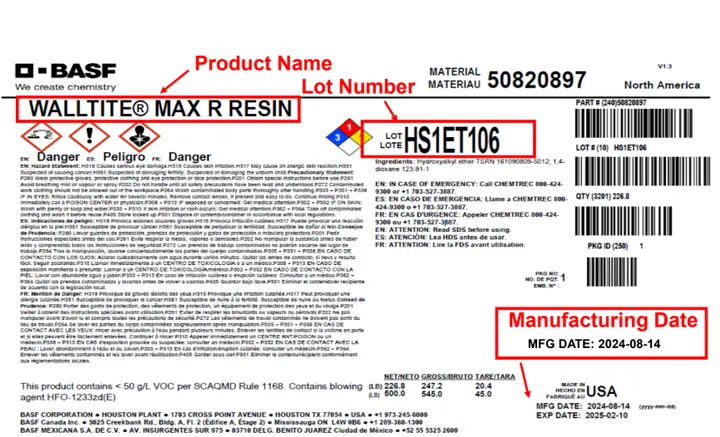
Before spraying, ask to see:
- The product name on both drums. It should match your quote.
- The date of manufacture. Code evaluation reports require it on every container. Resin past the shelf life on its data sheet shouldn't be sprayed.
- The lot numbers. Ask for them on your paperwork. A careful installer records them on every job.
Opened drums
The rated shelf life applies only to drums that have never been opened. Once a drum is open:
- A-side: moisture in the air reacts with it. That forms crystals that clog filters and carbon dioxide that pressurizes the drum. Installers fit a desiccant dryer so only dry air gets in.
- B-side: blowing agent escapes, which makes denser foam and less of it. One manufacturer tells installers to move leftover material to a new drum and use it within 3 to 5 days.
Heat
The resin is the sensitive side. Its blowing agent is dissolved in it as a liquid.
- As the resin warms past its storage range (one manufacturer puts the point at 85°F), the blowing agent starts coming out of the resin. That causes frothing, poor-quality foam and pressure in the drum.
- A bulging drum got too hot. An A-side drum can also bulge from moisture. Manufacturers' instructions: don't open it, let it cool (one says 24 to 48 hours), and call technical service.
- Long exposure to heat speeds up a slow reaction between the HFO blowing agent and the catalysts in the resin. The resin then reacts sluggishly, and foam made from it can have poor cells or collapse.
- Resin that froths at the pump makes it hard to hold the 1:1 mix. Manufacturers allow only a small ratio variance, typically 2 to 5%. Off-ratio foam is a leading cause of lingering odor.
A spray trailer in the July sun is not storage. Ask where the drums are kept between jobs. More detail: spray foam shelf life and storage and off-ratio spray foam.
4. The paperwork
Pennsylvania's Home Improvement Consumer Protection Act sets these rules:
- Registration. Anyone doing $5,000 or more of home improvement a year must register with the Attorney General and print the number on ads, estimates and contracts. Check it at hicsearch.attorneygeneral.gov or 1-888-520-6680.
- Insurance. At least $50,000 personal-injury and $50,000 property-damage liability, stated in the contract. An employer also needs workers' compensation.
- A written contract for jobs over $500, signed by both of you. It must include the registration number, start and finish dates, a description of the work and materials, the total price, and a notice of your right to cancel within 3 business days.
- Deposits. No payment before you sign. On contracts over $5,000, the deposit can't exceed one-third of the price plus the cost of special-order materials named in the contract.
A federal rule applies too. The FTC R-value Rule requires installers to give you a receipt showing coverage area, thickness and R-value. See how to read a spray foam quote.
This is a summary, not legal advice. The full act is 73 P.S. § 517.1 and following.
5. On the job
A careful installer:
- Gives you a written plan to vacate, ventilate and re-enter. Manufacturers call for ventilation during spraying and for about 24 hours after. See how long to stay out.
- Wears a respirator, chemical-resistant gloves and coveralls.
- Checks that wood moisture is 19% or less and that surfaces are at least 5°F above the dew point.
- Sprays in passes within the product's limit and lets each pass cool before the next (one manufacturer says until the core is below 100°F). Limits are commonly 2 to 5 inches per pass; a few high-lift foams allow more in cool weather and less above 80°F.
- Keeps foam off knob-and-tube wiring, out of junction boxes, off chimneys and flues, and 3 in. away from recessed lights.
- Covers foam in living space with a thermal barrier, usually ½ in. drywall, and plans ignition barriers in attics and crawl spaces where code requires them. See thermal vs ignition barriers.
- Can show training: manufacturer authorization, SPFA certification or ACC spray foam safety training.
6. What finished foam should look like
Good foam is even, smooth and uniform in color. Warning signs: cracks, shrinkage pulling away from the framing, a scorched or yellow-brown core, foam that is crumbly or sticky, or a smell that lasts past the re-entry time. Our visual guide to bad spray foam has photos and what each sign usually means.
How FoamGuard does it
We spray closed-cell and open-cell foam from tier-1 manufacturers, including Huntsman and BASF, and FoamGuard is a certified installer for both. We're an SPFA member (#52104571) and ACC SPF-Safety trained, and we record drum lot numbers on every job. Every job carries the manufacturer's product warranty and our written 5-year craftsmanship warranty, A Craftsman's Promise. You can look up a warranty at foam-guard.com/warranty.
Want a number for your own project? Price My Project or call (814) 208-3478.
FAQ
How long is spray foam good for in the drum?
Most closed-cell A-sides are rated about 12 months and resins about 3 to 6 months, unopened and stored within the product's temperature limits. The data sheet for your product has the exact figure.
How do I check a Pennsylvania contractor's registration?
Search the contractor's name or registration number at hicsearch.attorneygeneral.gov, or call the Attorney General's office at 1-888-520-6680.
What does a spray foam product warranty cover?
Terms vary by manufacturer. One major manufacturer's closed-cell limited lifetime warranty covers the product for the life of the building if an authorized contractor installed it and you registered within 90 days. It repairs or replaces the product but not the labor, which is why the installer's workmanship warranty matters.
Is a bulging foam drum dangerous?
It is under pressure. Manufacturers tell installers not to open a drum that bulged from heat, to let it cool (one says 24 to 48 hours) and to call technical service. Stay clear and leave it to the installer.
Sources
- Huntsman Building Solutions: HEATLOK HFO High Lift Technical Data Sheet (rev. 11.25.24)
- Huntsman Building Solutions: HEATLOK HFO High Lift Application Guide (rev. 11.25.24)
- BASF: WALLTITE Closed-Cell SPF Application Guidelines
- ICC-ES: ESR-2642, BASF WALLTITE closed-cell foams
- Huntsman Building Solutions: Closed-Cell Limited Lifetime Warranty
- ICC-ES: ESR-4073, Huntsman HEATLOK HFO High Lift
- Huntsman Building Solutions: ProSeal Best Practices
- Huntsman Building Solutions: Isocyanate Component A Safety Data Sheet
- Johns Manville: JM IV HFO Installation Guide
- Tosoh Research & Technology Review: catalysts for HFO-blown polyurethane foam (2017)
- Light, E.: Assessment and Remediation of Misapplied SPF, ASTM STP 1589
- U.S. EPA: Contractor-Client Communications Checklist for SPF
- U.S. EPA (archive): Safer Workplace Practices for SPF Installation
- U.S. CPSC: SPF Insulation, Health and Safety Recommendations for Consumers
- PA Office of Attorney General: Home Improvement Consumer Protection Act (Act 132 of 2008)
- PA Office of Attorney General: Home Improvement Contractor Registration FAQ
- PA Office of Attorney General: HIC registration search
- PA Dept. of Labor & Industry: Workers' Compensation Employer Information
- FTC R-value Rule, 16 CFR 460.17
- SPFA: Professional Certification Program