
Short answer
Good spray foam is one even color, firm, and bonded tight to the framing and sheathing. Bad spray foam shows up as dark, brittle or crumbly patches, soft or sticky spots, scorched yellow-brown areas, cracks, foam pulled away from the wood, or a fishy smell that doesn't fade. You can spot most of these signs by eye, but confirming the cause takes core samples and the manufacturer's technical service. Photograph anything suspect and keep it uncovered until it's checked.
Key points
- Good closed-cell foam has one even color, small tight cells, a smooth to lightly textured skin and no gaps at the framing.
- Too much A-side usually leaves foam darker, hard and crumbly. Too much B-side leaves it soft and sticky. Either can shrink.
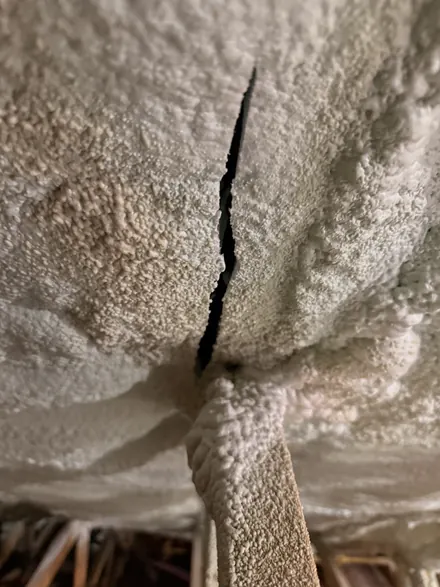
- Passes sprayed too thick overheat. Look for scorched or yellow-brown cores, cracks, and foam that has pulled off the framing.
- Rough texture alone doesn't prove bad spray foam. Cracks, gaps, sticky spots and a lasting odor are stronger signs.
- Don't drywall over suspect foam. Photograph it, ask the installer for the job records and call the manufacturer.
What good spray foam looks like
Spray foam is made on site from two liquids, the A-side (isocyanate) and the B-side (resin blend), mixed 1:1 by volume in the gun (Spray Foam 101 shows how). Done right, the cured foam looks the same from one end of the job to the other.
Check for these:
- Color: one even shade across the job. Manufacturers describe cured closed-cell foam as cream or pale yellow to off-white, and some brands tint theirs.
- Surface: smooth to a light orange-peel texture.
- Cells: on a cut edge, "uniform, small and tight," in one manufacturer's words.
- Feel: closed-cell is rigid. Open-cell is soft by design, so softness is only a warning sign in closed-cell foam.
- Bond: tight to studs, rafters and sheathing, with no gaps at the edges.
- Smell: fades after the ventilation period. See spray foam smell.
Color alone proves little: one manufacturer notes that sunlight during construction can discolor the surface without hurting performance. Color plus a texture, feel or bond problem deserves a closer look.
Bad spray foam: a visual checklist
| What you see | What it usually means |
|---|---|
| Dark brown, hard or crusty foam that turns chalky or crumbles when rubbed | Too much A-side (iso-rich) |
| Closed-cell foam that is soft, spongy or sticky to the touch | Too much B-side (resin-rich) |
| Yellow-brown or dark stains in the core, charring, or smoke during spraying | A pass sprayed too thick or too fast; the heat couldn't escape |
| Cracks or splits through the foam | Overheated thick passes and shrinkage, sometimes off-ratio foam |
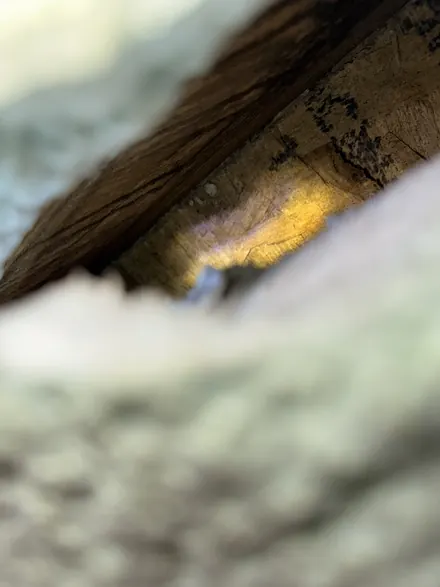
| Gaps where foam has pulled away from wood or metal | Poor adhesion (wet, frosty, dirty or cold surface) or shrinkage |
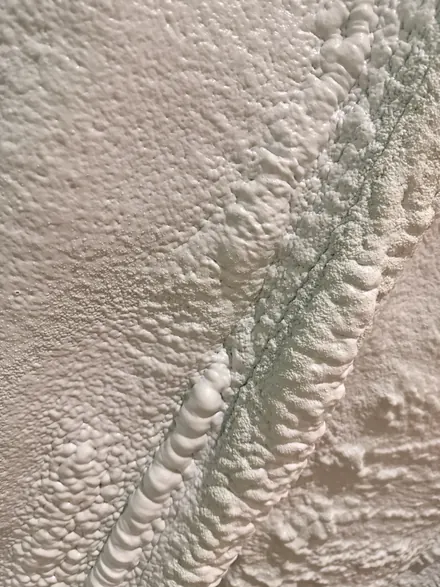
| Lumpy "popcorn" texture, ridges or ripples | Gun distance, speed or overlapping passes; not proof of a defect by itself |
| A fishy or chemical odor that lasts past the ventilation period | Misapplied foam, often unreacted catalyst |
Too much A-side or B-side
Off-ratio foam got more of one liquid than the other, so the extra has nothing to react with and the foam doesn't cure as designed. The industry's Center for the Polyurethanes Industry says it "is often easy to detect by visual inspection."
Troubleshooting guides from manufacturers and an equipment maker agree on the main signs:
- A-side heavy: darker brown ("coffee-colored" in one guide), crusty and brittle, with a chalky surface that crumbles. It may shrink.
- B-side heavy: soft and sticky, and it may shrink. Color is a weak clue: one manufacturer calls it darker, a distributor calls it pale, almost white. Go by feel.
The B-side blend carries the catalysts, typically amines. A persistent "fishy" odor is a classic marker of misapplied foam, and a paper published by ASTM names amine catalysts as significant contributors to it. Our off-ratio spray foam guide covers causes and removal.
Too hot or too thick per pass
Foam makes its own heat as it cures. Each product's application guide sets a maximum thickness per pass, from about 2 inches to 6.5 inches depending on the product and temperature, plus a cooling wait before the next pass. Manufacturers warn that spraying too thick or too fast can scorch or char the foam, leave lasting odors and, in extreme cases, start a fire.
What you may see afterward: yellow-brown or dark stains inside the foam, cracks, and foam that shrinks away from the framing. A building scientist writing in the Journal of Light Construction described overheated foam that shrank and cracked months later, in cold weather. Smoke or a burnt smell during spraying is a reason to stop and ask questions.
The three photos below come from one job where the foam was sprayed too hot.
Poor adhesion and gaps
Foam should stay stuck to everything it touches. Manufacturer guides list the usual reasons it doesn't: water, frost or dew on the surface, dust or oil, wood above roughly 18 to 19% moisture, spraying too close to the dew point, and cold. Overheated foam that shrinks can also pull itself off the framing.
A gap at a rafter, stud or panel edge is an air leak and a place where moisture can condense. Where foam has let go and the wood behind it is bare, with no foam left stuck to it, the surface was likely wet or cold when it was sprayed.
Rough texture and ridges
Closed-cell foam isn't sprayed smooth like paint, and some texture is normal. One manufacturer's guide says holding the gun too far away leaves "a rough, popcorn like finish and lower yield," and moving it too slowly makes the foam ripple. Ridges form where passes overlap.
Texture alone isn't proof of bad foam, but lumpy foam can hide thin spots, so it's a reason to check thickness. Cracks along a ridge are a different matter.
What you can judge by eye, and what needs testing
| You can check yourself | Needs a professional or a lab |
|---|---|
| Gaps at framing, cracks and splits | Whether the foam is actually off-ratio |
| Soft or sticky spots in closed-cell foam (gloved finger) | Scorching inside the foam (core sample) |
| Uneven color across the job | Density and cell structure (cut sample, lab test) |
| Bare wood or thin spots showing through | Thickness against the quote (depth probe) |
| Odor that lasts past the ventilation period | Source of the odor (core samples, air testing) |
Surface signs point the way, but a paper on misapplied foam published by ASTM notes that "core sampling may be necessary." That's a job for the installer, the manufacturer's technical service or an independent inspector: CPSC staff warn that disturbing foam improperly might generate dust or hazardous materials.
Ask to see the test spray
Before foam goes on your building, manufacturers call for a test spray on scrap to check reactivity, density, spray pattern, mix and cell quality. If you're on site, ask to see it.
A good pattern is round, full and even. An uneven, hollow or doubled pattern means the gun or equipment needs attention first.
What to do if you find bad spray foam
- Photograph it with a tape measure for scale. Note the date, the location and any smell.
- Keep it uncovered. Don't let drywall, paneling or other trades close it in until it's resolved.
- Don't cut, sand or heat it yourself.
- Ask the installer, in writing, for the job records: product name and data sheet, drum lot numbers, air and surface temperatures, moisture readings, and the thickness sprayed per pass. Federal rules already require a signed receipt showing coverage area, thickness and R-value.
- Call the manufacturer's technical service with the product, lot numbers and your photos. Ask what testing they recommend.
- Get an independent opinion if the answers don't add up: a certified installer from another company, a building-science consultant or, for odor, an indoor air quality consultant, as CPSC staff suggest.
- If it's still unresolved, CPSC staff point homeowners to their state or local consumer protection office or contractor licensing board.
Most of this is prevented before the job starts; see our guide to choosing the right spray foam contractor.
FoamGuard records drum lot numbers on every job. Questions about foam in your own building? Call (814) 208-3478 or Price My Project.
FAQ
Is yellow spray foam bad?
Not by itself. Many closed-cell foams cure cream to pale yellow, and sunlight during construction can discolor the surface. Yellow-brown or dark staining inside the foam, especially with cracks or a burnt smell, is the warning sign.
Can I check my spray foam without damaging it?
Yes. Look, photograph, smell, and press closed-cell foam lightly with a gloved finger: it should feel rigid and dry. Leave cutting and core samples to the installer, the manufacturer or an inspector.
Will bad spray foam fix itself over time?
Generally no. Off-ratio foam doesn't finish curing later, because the excess chemical has nothing left to react with, and cracks and gaps don't close on their own. The usual remedy is to cut out the bad foam and respray.
Sources
- American Chemistry Council, Center for the Polyurethanes Industry: High Pressure SPF Insulation, Worker and Homeowner Health and Safety Information (2019)
- Huntsman Building Solutions: FOAMLOK 2000 Installation Instructions (troubleshooting section)
- Huntsman Building Solutions: HEATLOK HFO High Lift Product Application Guide (rev. 11.25.24)
- BASF: WALLTITE Series HFO Closed-Cell SPF Application Guidelines (Feb. 9, 2023; distributor-hosted copy)
- Graco: What Is My Spray Pattern Telling Me? (Reactor troubleshooting guide)
- Light, E.: Assessment and Remediation of Misapplied Spray Polyurethane Foam, ASTM STP 1589 (2017)
- Fennell, H.: Avoiding Problems With Spray Foam, Journal of Light Construction
- Spray Foam Systems: A Look at Abnormal Foam Insulation Colors and What They Mean
- US CPSC staff: Spray Polyurethane Foam Insulation Health and Safety Recommendations for Consumers
- FTC R-value Rule, 16 CFR 460.17: what installers must put on the receipt