
Short answer
Closed-cell spray foam ships in two drums with two different clocks. For most products the A-side (isocyanate) is good for about 12 months and the B-side (resin) for 3 to 6 months, unopened and kept inside the manufacturer's storage range. Heat, freezing and humid air shorten that, so how the drums were kept matters as much as the date on the label.
Key points
- The resin (B-side) is the short clock: usually about 6 months, as short as about 3 for one HFO resin. The A-side usually gets 12 months.
- Storage ranges are narrow: 50°F at the bottom and 70–80°F at the top for the resin, depending on the product.
- Heat pushes the blowing agent out of the resin and can bulge a drum, which shouldn't be opened until it has cooled.
- Moisture attacks the A-side. It forms crystals that clog filters and gives off carbon dioxide that can pressurize a sealed drum.
- Every drum label shows the product name, a lot number and a manufacture date, and some brands add an expiry date. You can ask to see them.
Why spray foam shelf life matters
Spray foam isn't finished when it leaves the factory. It is two liquids that become insulation on your wall in the few seconds after they meet in the spray gun. Spray Foam 101 walks through that reaction.
If either liquid has drifted from its design, the foam made from it can drift too. Spray foam shelf life is the window in which the manufacturer stands behind each liquid, provided the drum stayed sealed and inside its storage temperatures. At least one application guide says the resin's shelf life holds only if the drum's bungs were never removed.
Shelf life and storage temperatures by product
Shelf life differs by manufacturer and even within one product line. Here are published numbers for closed-cell foams from four tier-1 makers, listed alphabetically.
| Product (document) | A-side shelf life | B-side (resin) shelf life | Storage temperature |
|---|---|---|---|
| BASF WALLTITE HFO series (application guidelines, Feb 2023) | 12 months from manufacture | About 6 months (LWP, XL); about 3 months (Plus) | 50–80°F, out of direct sunlight |
| Carlisle Foamsulate Closed Cell (application guide, July 2021) | 6 months from manufacture | 6 months from manufacture | 50–80°F |
| Huntsman HEATLOK HFO High Lift (data sheet, Nov 2024) | 12 months | 6 months | A: 50–100°F; B: 50–70°F |
| Johns Manville JM IV HFO (processing parameters, June 2025) | 12 months | 6 months | 50–80°F |
The pattern: about 12 months for the A-side, 3 to 6 months for the resin, and a storage floor of 50°F.
Two details are easy to miss. Some manufacturers count shelf life from the date of manufacture, so a drum that sat in a warehouse has already used part of its window. And data sheets get revised, so an installer needs the current one, not the copy that has been riding in the truck for four years.
How to read a drum label
Every drum carries a printed label. Past the hazard and shipping information, a few items tell you whether the chemical is the right product and still in date.
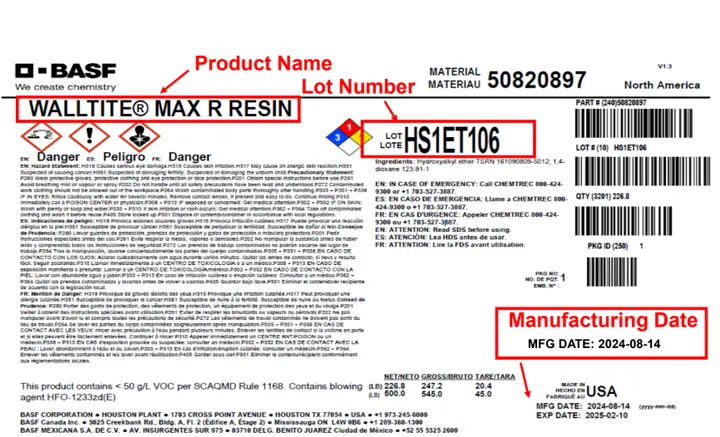
- Product name and side. It should match the product on your quote (how to read a spray foam quote) and show whether the drum is the A-side or the resin.
- Lot number. The production batch. It ties the job record, and any question to the manufacturer, to the drums used on your walls.
- Manufacture date. The start of the shelf-life clock. The ICC-ES evaluation reports for BASF's and Huntsman's closed-cell foams both require it on every A and B container.
- Expiry date, on some brands. The label above shows a manufacture date of 2024-08-14 and an expiry date of 2025-02-10, about 6 months later. Without an expiry date, add the product's shelf life to the manufacture date.
If a label shows only a lot code, ask the installer how to read the date from it.
What heat does to the resin
The B-side is a blend of polyols, catalysts, flame retardant, surfactants and the blowing agent, which in HFO foams is dissolved in the resin as a liquid. Warm the drum and the blowing agent starts to come out of solution; one manufacturer tells installers to keep its resin at or below 85°F, because above that the resin can froth.
That gas has to go somewhere, so an overheated resin drum bulges. The guidance is clear: don't open a heat-bulged drum. One HFO guide says to cool it for about 24 to 48 hours so the blowing agent returns to a liquid, then call technical service. Another notes that warm storage shortens shelf life and raises pressure in the drum.
Resin that has lost blowing agent makes denser foam, and less of it. A spray trailer that sits in the July sun all afternoon is not a storage room.
What moisture does to the A-side
The A-side is polymeric MDI, an isocyanate, and isocyanate reacts with water. The American Chemistry Council's handling guide warns that this reaction slowly gives off carbon dioxide, which in a closed drum "could cause a violent rupture." Its advice for a bulging isocyanate drum is to isolate the area and get expert help, not to open it on the spot.
The same reaction forms solids. One manufacturer's instructions say not to open drums until needed, because humid air entering the A-side drum causes crystals that clog the filter screens protecting the pump and gun. A partly clogged screen starves one side of the mix, one road to off-ratio spray foam.
Good habits with an opened A-side drum:
- Keep the bungs closed: remove the transfer pump and close the bungs tightly after use.
- Let air in only through a desiccant dryer, so the air replacing the chemical is dry.
- Never reseal or refill a container that may have water in it. The ACC guide calls for a pad of dry nitrogen or dry air on bulk isocyanate containers for this reason.
What cold does
Freezing hurts both sides. Manufacturers warn that cold resin can separate and a cold A-side can form crystals, and chemical colder than 50°F may be hard to pump. Guides call for bringing drums up to about 70–80°F before spraying, in a warm room or under drum heat blankets; one specifies 48 hours at that temperature.
In Western Pennsylvania, that means drums spend the winter somewhere heated, not in an unheated trailer through a January cold snap. Warming cold drums can take hours or days.
What a homeowner can ask to see
A good installer won't mind these questions.
- The drum labels. Product names on the A and B drums that match your quote.
- Lot numbers for both drums. Take a photo, or ask for them on your paperwork.
- The manufacture or expiry date. The resin should be inside its window on spray day; for most resins that's 6 months or less from manufacture.
- Where the drums live between jobs. Heated in winter, out of the sun in summer.
- How opened drums are protected. Closed bungs and a dryer on the A-side drum.
Warning signs: unlabeled or unreadable drums, a bulging drum on the truck, or a low price explained by "we got a deal on older material." For what problems look like once the foam is on the wall, see how to spot bad spray foam.
FoamGuard records drum lot numbers on every job, and you can look up a FoamGuard warranty at foam-guard.com/warranty. For more questions to ask before hiring anyone, see how to choose a spray foam contractor.
Want a number for your own project? Price My Project or call (814) 208-3478.
FAQ
Can expired spray foam still be sprayed?
Not with any confidence. Past its shelf life the resin may have lost blowing agent or catalyst strength, and the manufacturer no longer stands behind it. Anyone holding an out-of-date drum should call the manufacturer's technical service before it goes near a wall.
Does shelf life matter once the foam is cured?
No. Shelf life applies to the liquid chemicals in the drum. Once the two sides are properly mixed and cured, the foam is a solid plastic, and its coverage comes from the product and workmanship warranties.
Why does the resin expire before the A-side?
The resin blends several ingredients, including a dissolved blowing agent and catalysts, so more can change with time and temperature. The A-side mostly gets 12 months, as long as it stays dry and in range.
Where do I find the lot numbers after the job?
Ask your installer; they belong in the job record. If an installer can't say which lots went on your walls, that tells you something about their record-keeping.
Sources
- BASF: WALLTITE Series HFO Closed-Cell SPF Application Guidelines (rev. Feb 9, 2023)
- ICC-ES: ESR-2642, BASF WALLTITE LWP, MAX and ONE Spray-Applied Polyurethane Foam Insulation (reissued Jan 2026)
- Carlisle Spray Foam Insulation: Foamsulate Closed Cell Application Guide (07.12.21)
- Huntsman Building Solutions: HEATLOK HFO High Lift Technical Data Sheet (rev. 11.25.24)
- Huntsman Building Solutions: HEATLOK HFO High Lift Product Application Guide (rev. 11.25.24)
- ICC-ES: ESR-4073, Huntsman Heatlok HFO High Lift Spray Foam Insulation (reissued Aug 2026)
- Huntsman Building Solutions: FOAMLOK 2000 Installation Instructions
- Johns Manville: JM IV HFO Closed Cell SPF Processing Parameters (BID-491, 06/25)
- Johns Manville: JM Corbond IV Closed-Cell SPF Installation Guide (Canada)
- American Chemistry Council, Center for the Polyurethanes Industry: Safe Handling of Methylenediphenyl Diisocyanate, Leader's Guide