
Short answer
Spray foam is not a product that arrives finished. Two liquids become insulation in the seconds after they meet at the gun, so the installer is the final manufacturer, and the manufacturer's data sheet says so in writing. Three things go a long way to deciding whether the foam on your wall performs to its published specification: the material tier, the condition of the equipment, and how often the person on the gun does this work. A contractor who sprays foam as an occasional add-on has the hardest time controlling all three. Some do it well. The way to know is to ask the same questions you would ask a specialist, and to get the answers in writing.
Key points
- "It is the sole responsibility of the applicator to process and apply Heatlok HFO High Lift within specification." That sentence is on the product's own data sheet, and BASF says the same thing in its own words.
- The top closed-cell products are gated. Huntsman's code report requires foam "applied by contractors authorized by Huntsman Building Solutions, LLC"; BASF's application guidelines say "TO BE INSTALLED ONLY BY PROPERLY TRAINED CONTRACTORS", and its code report calls for installers approved by BASF or by the Spray Polyurethane Foam Alliance.
- The equipment can't sit. Graco's own training checklist says to purge the isocyanate side "if not spraying weekly"; its Reactor manual explains why: moisture turns it into "small, hard, abrasive crystal", which the checklist says "plugs filters, damages seals".
- The industry's yardstick for an experienced installer is volume: the SPFA certifies an Installer at 100,000 board feet of spraying and a Master Installer at 500,000. Ask how many board feet the person on your job has sprayed.
- In Pennsylvania the contract must name the performing contractor's registration number and every known subcontractor. Who will stand behind the foam in year five should be on paper before the first drum is opened.
Spray foam is made on your wall, not in a factory
A fiberglass batt is the same product whether a carpenter, a roofer or an insulation crew stuffs it in the cavity. Spray foam is different. It is shipped as two liquids in two drums, the A-side (isocyanate) and the B-side (resin), and becomes insulation only after a heated proportioner meters them at a 1:1 ratio by volume, pushes them down a heated hose at well over 1,000 psi, and mixes them inside the gun. Spray Foam 101 walks through the machine.
That is why the product makers put the responsibility where it belongs. Huntsman's data sheet for HEATLOK HFO High Lift reads: "It is the sole responsibility of the applicator to process and apply Heatlok HFO High Lift within specification." BASF's application guidelines open with "TO BE INSTALLED ONLY BY PROPERLY TRAINED CONTRACTORS."
The practical meaning: the R-value, the air seal, the vapor retarder rating and the fire test results on the data sheet describe foam that was processed within specification. Foam processed outside it is a different, untested material, and that is one place lingering odor, poor adhesion, cracking and shrinkage start. Off-ratio spray foam and how to spot bad spray foam show what that looks like.
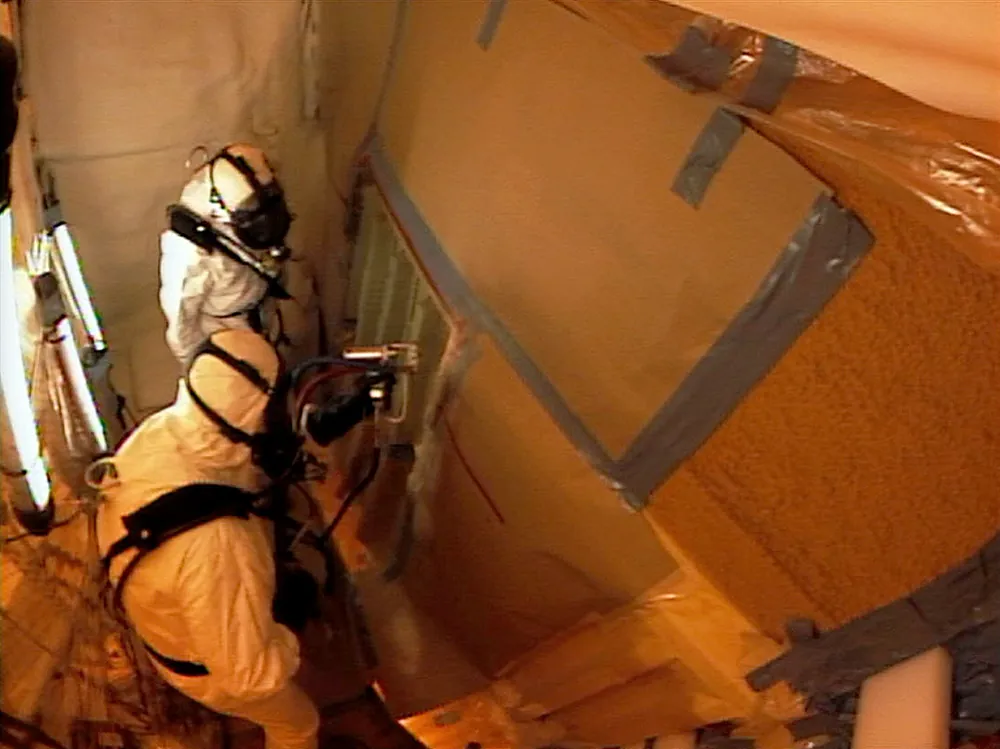
The foam NASA sprays on a tank is the same family of material, two liquids mixed at the gun; spray foam on rockets tells that story.

The three things an add-on service struggles to control
A general contractor who frames, roofs, sides and "also does spray foam", or an insulation shop that mostly installs batts and keeps a rig for the occasional foam job, has to solve three problems a full-time spray foam contractor solves every day.
1. The material tier
Not all spray foam is the same product, and not everyone can buy the best of it. The closed-cell foams with full code evaluation reports are sold through the manufacturer's channel, and their code reports require that they be applied by installers the manufacturer, or for BASF the SPFA, has approved. The reports make the gate explicit: ICC-ES ESR-4073 for HEATLOK HFO High Lift says the insulation "must be applied by contractors authorized by Huntsman Building Solutions, LLC", and Intertek's CCRR-0374 for BASF WALLTITE calls for "professional spray polyurethane foam installers approved by BASF Corporation" or approved by the SPFA.
Foam bought outside that channel, or from a maker with no evaluation report, carries none of the checks that come with it: no training requirement, no technical service line to call when a drum looks wrong, no published processing window, and a product warranty that may not exist. Who can buy top-tier spray foam goes through the chain in detail.
2. The equipment hours
The isocyanate side of a spray rig is chemically hostile to idle time. Graco's Reactor manual: "Exposure to moisture (such as humidity) will cause ISO to partially cure, forming small, hard, abrasive crystal that become suspended in the fluid. Eventually a film will form on the surface and the ISO will begin to gel, increasing in viscosity." Graco's training checklist is blunter: the isocyanate "crystallizes, plugs filters, damages seals", so "purge material if not spraying weekly", and "if system not being used for 1-2 weeks purge or circulate material."
A rig that is pulled out of the shop once a month for an add-on job is exactly the rig those sentences describe. Partially crystallized A-side means a restricted screen on one side, which means a pressure imbalance between A and B, which is the textbook route to off-ratio foam. Why spray foam equipment can't sit idle covers the maintenance clock in detail.
3. The reps
The Spray Polyurethane Foam Alliance runs the industry's certification program, built to ISO 17024 according to a 2014 Construction Specifier article. Its levels are defined by experience: an Installer has sprayed 100,000 board feet, a Master Installer 500,000. A 40 × 60 pole barn with 14-foot walls, sprayed on the walls, gables and roof at 2 inches, is roughly 11,200 board feet (the arithmetic is on the pole barn quote page), so a Master Installer has sprayed the equivalent of about 45 of them. Judgment about substrate temperature, pass thickness, a changing spray pattern or a drum that is reacting slowly is built by repetition, and there is no shortcut to it.
| What decides the result | What a full-time specialist can show | The question that checks it |
|---|---|---|
| Material | Bought through the maker's channel as an authorized installer, lot numbers recorded | Which exact product, and is there a current ESR or CCRR for it? |
| Equipment | Sprayed weekly or purged and recirculated; screens, seals and TSL on a schedule | When did this rig last spray, and when were the A-side screens, wet cups and gun seals serviced? |
| Installer | Hundreds of thousands of board feet; recognizes a problem in the first pass | How many board feet has the person on my job sprayed? |
| Warranty | Written workmanship warranty plus the maker's registered product warranty | What does the written workmanship warranty cover, and will the product warranty be registered in my name? |
The price trap
What to watch for. A quote comes in a little under the specialists' range. The line items look the same: square feet, inches, a lump sum. When two quotes differ, the difference can sit behind the number: which product and whether it has a code report, when the equipment was last serviced, and what the warranty actually says. Ask all three.
Published numbers make this easy to check. FoamGuard's installed price for closed-cell is $1.50 to $2.25 per board foot, and the free insulation cost calculator shows the Western PA and Eastern OH market range beside it. If a quote lands under the market range with the same product, same thickness and same warranty, ask what gave.
Who is responsible when an add-on job goes wrong
Pennsylvania's Home Improvement Consumer Protection Act says a home improvement contract must contain "the home improvement contractor registration number of the performing contractor", "a description of the work to be performed, the materials to be used and a set of specifications", and "the names, addresses and telephone numbers of all subcontractors on the project" known when it is signed. So the first question is simple: whose registration number and whose name is on the foam?
Then the second: whose warranty? A tier-1 manufacturer's product warranty is conditional. Huntsman's closed-cell limited lifetime warranty, for example, applies to foam "installed by authorized contractors using trained applicators" and excludes "defects or failure caused by improper installation of Product (not in strict adherence with HBS's written instructions)", and it covers material only, not labor. If the installer was not authorized, or the foam was processed outside specification, the manufacturer has a written reason to decline the claim, and the only warranty left is the installer's own. That is the moment a "we'll take care of you" promise is tested. This is a summary of public documents, not legal advice.
When a general contractor is the right call
A builder who schedules the job, opens up the walls, and brings in a specialist whose name goes into the contract as the subcontractor is doing it right. The foam is then sprayed by someone who does it every week, with the material that contractor is authorized to buy, under a workmanship warranty that is actually written down. Some general contractors and insulation companies run a full-time foam division; they will pass every question below without hesitation. The questions are the test, not the business card.
Six questions that sort the two
- Which exact product, and can I see its technical data sheet and evaluation report number?
- Are you authorized by that manufacturer, and will the product warranty be registered in my name?
- When was the rig last sprayed, and when were the A-side screens, TSL and gun seals last serviced?
- Will you spray a test pattern before you start on my building, and may I see the pressure and temperature settings you are running?
- Will I get the drum lot numbers and photos in a project file?
- What does your written workmanship warranty cover, for how long, and who inspects a claim?
The 15 red flags on the contractor guide cover the paperwork side: registration, written warranties, drum dates. Every answer above should come in writing.
FoamGuard sprays closed-cell and open-cell foam as its only trade, is a certified installer for both Huntsman and BASF, records the drum lot numbers on every job, and backs the work with a five-year craftsmanship warranty on top of the manufacturer's product warranty. Want a number for your own project? Price My Project or call (814) 208-3478.
Read next: Not All Spray Foam Is the Same: Who Can Buy the Top-Tier Products, and What the Code Report Requires · Why Spray Foam Equipment Can't Sit Idle: ISO Crystallization, Purging and the Weekly Clock · Off-Ratio Spray Foam: How to Spot It and What to Do.
FAQ
Can a general contractor install spray foam insulation?
Legally, yes, with a Pennsylvania home improvement contractor registration. Whether the foam performs depends on the material, the equipment and the installer's experience, which is why the manufacturers' code reports require authorized or approved installers.
Why does spray foam quality depend on the installer more than other insulation?
Because spray foam is manufactured on site. The data sheet values describe foam processed at the right ratio, pressures and temperatures. Foam processed outside those limits is a different material with different properties.
Is a cheaper spray foam quote always a worse job?
No, but a quote under the market range with the same product, thickness and warranty should prompt questions. Ask whether the difference is in the material tier, the equipment condition or what the warranty leaves out.
What should a spray foam warranty cover?
Two things in writing: the manufacturer's product warranty, registered in your name, and the installer's workmanship warranty naming the defects it covers, the term, the response times and who inspects a claim.
Sources
- Huntsman Building Solutions: HEATLOK HFO High Lift Technical Data Sheet (rev. 11.25.24)
- ICC-ES ESR-4073: Heatlok HFO High Lift Spray Foam Insulation (reissued August 2026)
- BASF: WALLTITE Series HFO Spray Foam Insulation Application Guidelines (Feb. 9, 2023)
- Intertek CCRR-0374: BASF WALLTITE Max and One Spray-Applied Polyurethane Foam Insulations (rev. Feb. 19, 2025)
- Graco: Reactor E-30 Operation Manual 333023, rev. U (Moisture Sensitivity of Isocyanates)
- Graco: Reactor Startup Checklist, Reactor & Fusion Training (Oct. 23, 2006)
- Spray Polyurethane Foam Alliance: Individual Certification Programs
- The Construction Specifier: Importance of qualified SPF installers (May 13, 2014)
- Huntsman Building Solutions: Closed-Cell Spray Foam Limited Lifetime Warranty (rev. 04.08.21)
- 73 P.S. § 517.7, Home Improvement Consumer Protection Act: home improvement contracts (FindLaw)
- NASA via Wikimedia Commons: STS-133 technicians spray foam on the tank (public domain)