
Short answer
Yes. The fuel tanks of NASA’s Space Launch System, Japan’s H3, China’s Long March 5 and Europe’s Ariane 6 are insulated with sprayed foam: two liquids mixed in a spray gun that expand into one seamless, closed-cell layer bonded to the tank. Engineers choose it where insulation has to be light, seamless and able to hold back −423°F. The closed-cell spray foam in a building is a close chemical cousin of that material, made and tested for buildings.
Key points
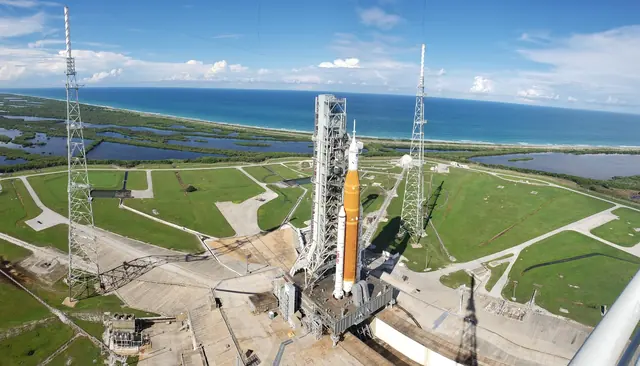
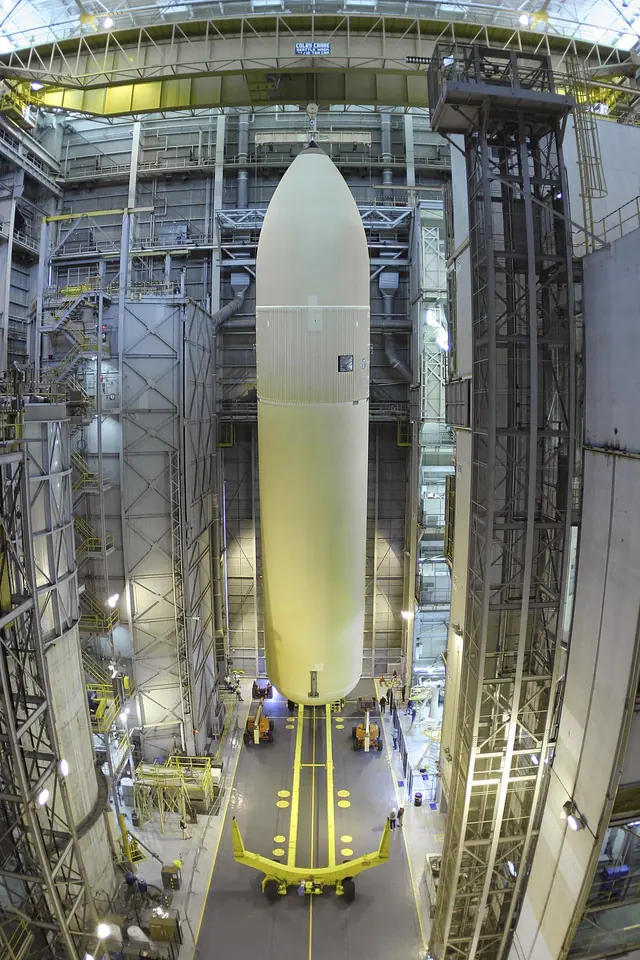
- Liquid hydrogen has to stay at −423°F and liquid oxygen at −298°F. Sprayed closed-cell foam is what keeps them there on NASA’s SLS core stage.
- NASA says its tank foams “are all closed-cell materials, which means they are stronger and have greater resistance to heat flow and moisture.”
- Like building spray foam, rocket tank foam is two liquids mixed at the gun and sprayed in place, by robot arm or by hand.
- The orange on SLS and Japan’s rockets is the bare foam itself. The Space Shuttle’s tank flew orange after its first two flights to save 600 pounds of white paint.
- Building foam is a cousin, not the same product: it is formulated, tested and code-approved for buildings, and installed by certified crews.
Why a rocket needs insulation at all
The most powerful rockets burn liquid hydrogen and liquid oxygen. Both are gases at room temperature, so they only stay liquid when they are extremely cold: NASA keeps liquid hydrogen at −423°F and liquid oxygen at −298°F. NASA’s Space Launch System (SLS) core stage carries 537,000 gallons of the first and 196,000 gallons of the second.
Every bit of heat that reaches the tank boils propellant away. Without insulation, humid Florida air would also freeze into ice on the tank walls, and the heat of launch would reach the propellant. The tank needs a skin that is light, seamless, bonded to curved metal, and able to hold back a temperature difference of more than 500 degrees. That skin is sprayed foam.
Five rocket programs, one answer
Rocket builders on three continents insulate their cryogenic tanks the same way:
| Rocket | Who builds it | Status | On the hydrogen and oxygen tanks |
|---|---|---|---|
| Space Launch System (SLS) core stage | NASA (USA) | NASA’s Artemis moon rocket | “Covered with an orange spray-on foam to insulate the cryogenic propellants” (NASA). The engine section at the bottom uses cork instead. |
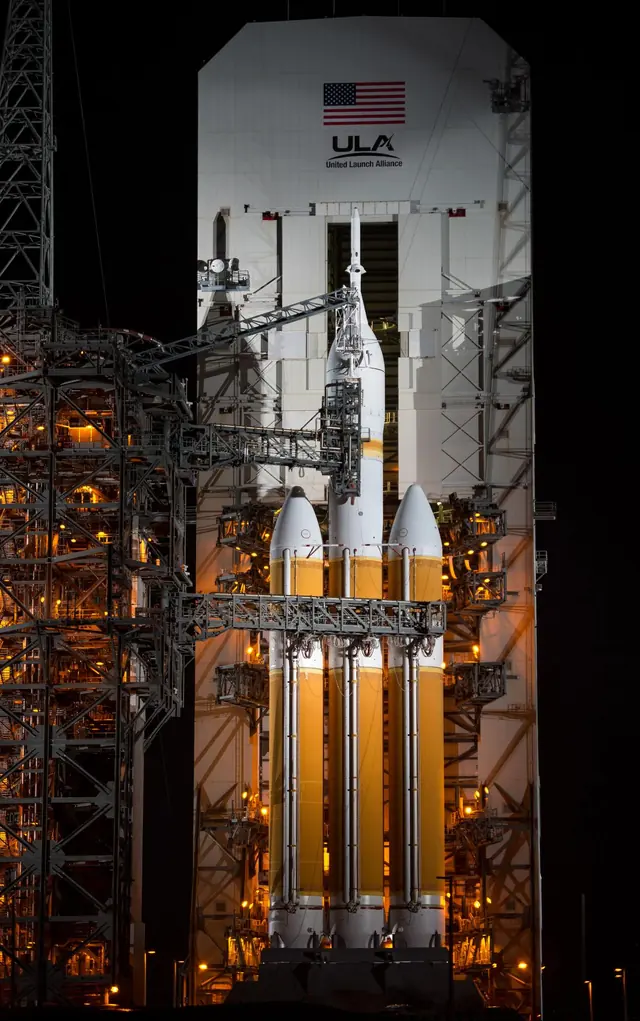
| Delta IV Heavy | United Launch Alliance (USA) | Retired; final flight April 9, 2024 | Booster tanks “insulated with a combination of spray-on and bond-on insulation” (ULA). |
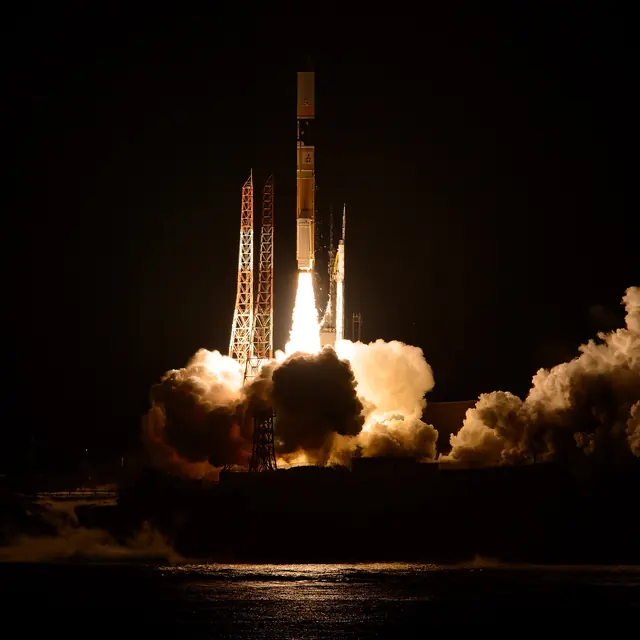
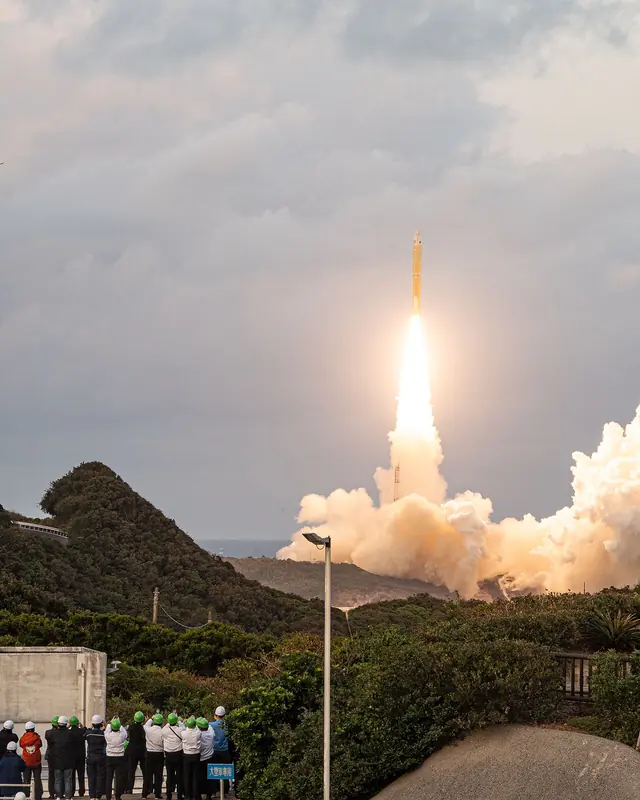
| H-IIA and H3 | JAXA and Mitsubishi Heavy Industries (Japan) | H-IIA retired June 2025; H3 is its successor | Sprayed orange insulation. On H-IIA, “this orange is not paint, but the insulation’s own color.” |
| Long March 5 family | China Aerospace Science and Technology Corporation | China’s heavy-lift rocket | A “low-density, fully closed-cell polyurethane foam” sprayed onto the tanks by a robot arm, under a protective outer layer. |
| Ariane 5 and Ariane 6 | ArianeGroup for ESA (Europe) | Ariane 5 retired 2023; Ariane 6 flying since 2024 | Foam insulation on the cryogenic tanks, sprayed by a robot arm on Ariane 6’s upper stage; the rocket has a white finish. |
The detail from China’s program will sound familiar to anyone who has watched a spray foam rig work: the robot’s spray gun has an impingement mixing chamber where the liquid components collide, mix and are sprayed onto the tank. That is the same principle as the plural-component gun on our rig, explained step by step in Spray Foam 101.


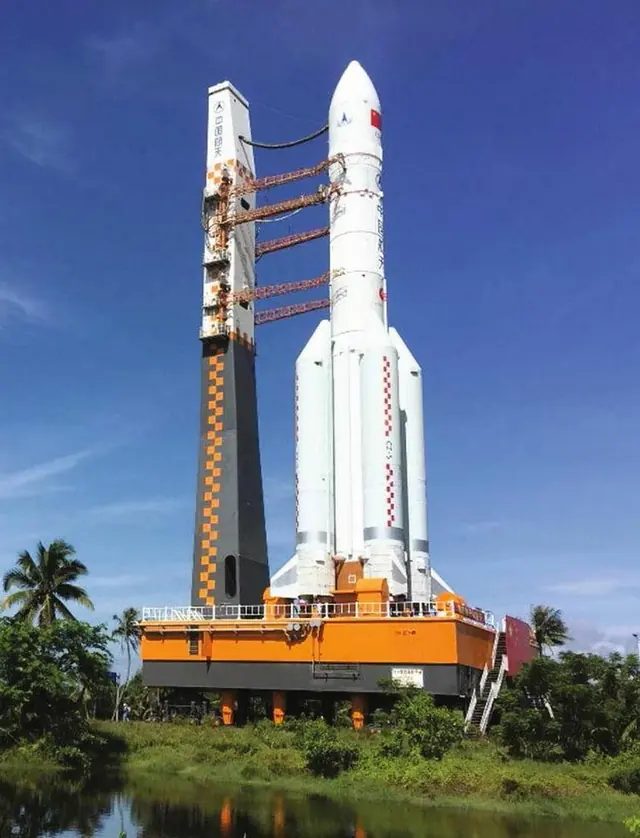

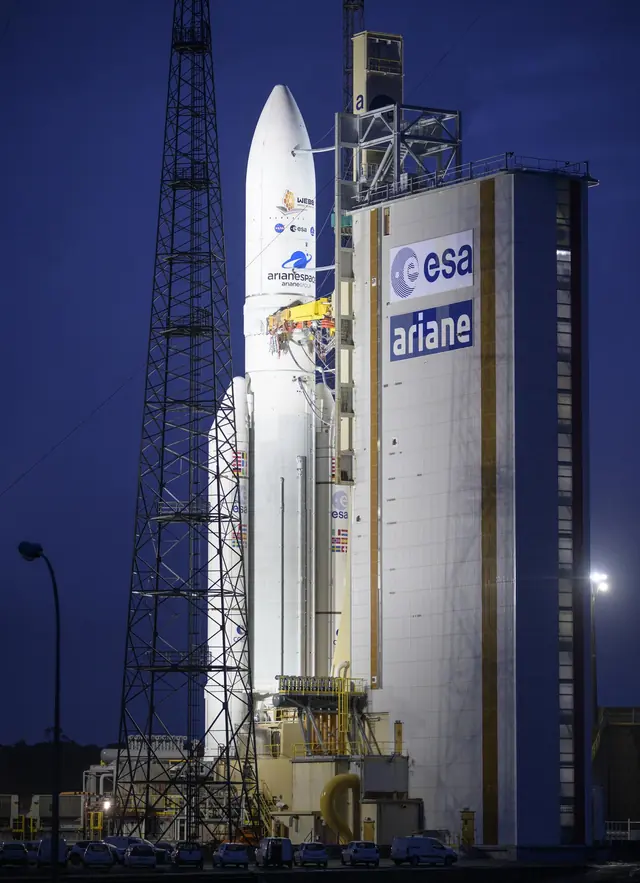
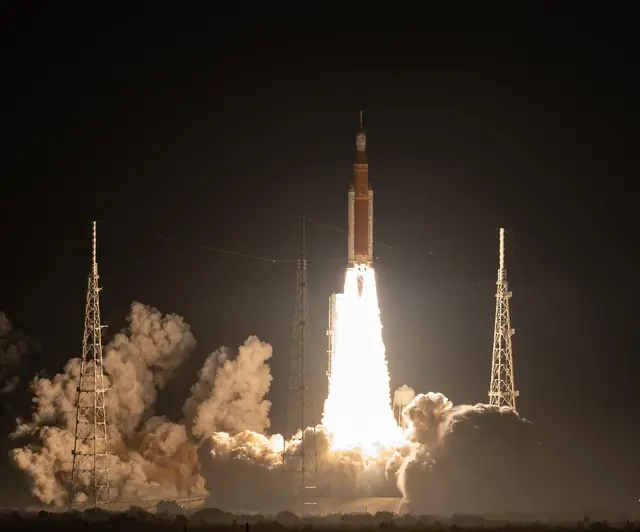
Why the rockets are orange
NASA’s foam goes on light yellow. Sunlight “tans” it, “giving the SLS core stage its signature orange color.” NASA leaves it unpainted.
The Space Shuttle showed why that matters. For its first two launches in 1981, the external tank was painted white. After that NASA left it the orange of its spray-on insulation, and the tank got 600 pounds lighter, weight that went to payload instead. Japan’s H-IIA flew the same way: its orange was the insulation itself. Europe’s Ariane 6 goes the other way: it is finished white to reflect sunlight.
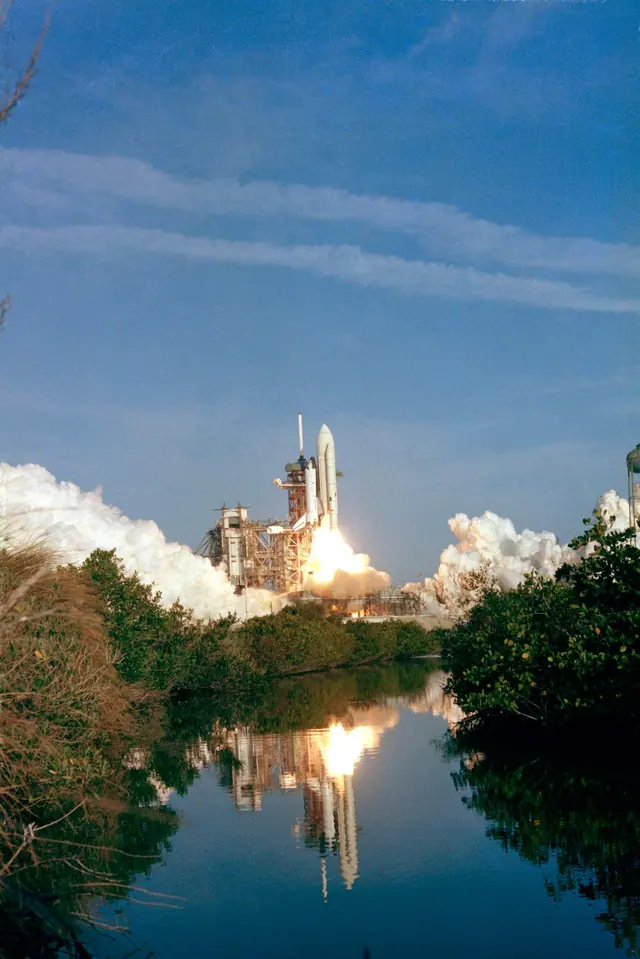
What rocket foam and building foam share
- Two liquids, mixed at the gun. NASA’s SLS foam is made from an isocyanate and a polyol blend that “mix in the spray gun.” Closed-cell spray foam for buildings is the same two-part idea, metered and heated by the rig and mixed at the tip.
- Closed cells. NASA says its tank foams “are all closed-cell materials, which means they are stronger and have greater resistance to heat flow and moisture.” That is exactly why closed-cell is the foam we spray against roof decks, metal panels and foundation walls.
- Bonded and seamless. Sprayed foam grips the surface it is sprayed on and leaves no seams. On a rocket that means no gaps for heat or ice. In a building it means no gaps for air, moisture or the cold spots that batts and boards leave at every joint.
- Light for what it does. On a launch vehicle every pound counts, which is why engineers want insulation this light that still holds back hundreds of degrees.
There is even a company that makes both. NCFI Polyurethanes, which supplied foam for the Space Shuttle’s external tank and says it supports SLS and Orion, also makes closed-cell spray foam insulation for buildings (InsulStar and InsulBloc).
What is different, and why it matters
Rocket tank foam and building foam are cousins, not the same product. According to NASA engineers quoted by NASASpaceflight.com, the SLS main tank foam is a polyisocyanurate formula, and its blowing agent boils at about 65°F, so the components are kept cold until they are sprayed. NASA qualified its foams on hundreds of 24-by-24-inch test panels exposed to launch heating. Building foam is formulated for walls and roofs and tested to building codes: fire tests, code evaluation reports and the thermal-barrier rules that apply inside a building.
The closed-cell foam FoamGuard sprays is Huntsman Heatlok HFO High Lift: R-7.4 per inch, an HFO blowing agent, and GREENGUARD Gold certified. It is a building product through and through. What it shares with the foam on a rocket is the chemistry and the reasons engineers trust it.
The lesson from the launch pad: application is everything
Rocket foam teaches one more thing. Its most famous failure, on the Space Shuttle Columbia in 2003, came when a piece of foam broke off a hand-sprayed ramp on the external tank during launch and struck the orbiter’s wing. NASA’s fix was not a new material. It removed or redesigned the ramps, and it tightened how foam is applied: practice on full-size mock-ups, video of every spray, and sprayers certified on the process.
That is the standard every good spray foam crew works to, on a rocket or a pole barn. The material only performs the way the data sheet says when it is applied the way the data sheet says. It is why our installers are certified, why we measure the surface before every lift, and why every drum on a FoamGuard job is lot-traced. The SLS core stage case study walks through how NASA does it.
Want the same class of material on your building? Price My Project or call (814) 208-3478.
NASA, JAXA, ESA, ArianeGroup, CASC and ULA are named here for facts only. None of them endorses FoamGuard, and FoamGuard’s building foam is not the foam used on these rockets.
FAQ
Is spray foam really used on rockets?
Yes. NASA’s SLS core stage is covered with an orange spray-on foam made from two liquids mixed in the spray gun, and Japan’s H3, China’s Long March 5 and Europe’s Ariane rockets also use sprayed foam on their cryogenic tanks. NASA says its tank foams are all closed-cell.
Is the foam in my building the same as NASA’s?
No. It is the same family of chemistry, two liquids mixed at the gun into a closed-cell foam, but rocket foam is formulated and qualified for launch, and building foam is formulated and tested for buildings and building codes. FoamGuard sprays Huntsman Heatlok HFO High Lift, a building product.
Why are rockets orange?
On NASA’s SLS and Japan’s H-IIA and H3, the orange is the bare foam insulation. NASA’s foam goes on light yellow and sunlight tans it orange. Leaving it unpainted saves weight: when NASA stopped painting the Space Shuttle’s external tank white after its first two flights, the tank got 600 pounds lighter.
Sources
- Space Launch System Core Stage, NASA (reference page)
- Foam and Cork Insulation Protects Deep Space Rocket from Fire and Ice, NASA (June 20, 2018)
- NASA Tests New Insulation for SLS Rocket, NASA (September 2, 2016)
- 50 Years Ago: NASA Selects Contractor for Space Shuttle External Tank, NASA History (2023)
- Protecting SLS from fire and ice: TPS foam application proceeding at MAF, NASASpaceflight.com (December 2017)
- Final Delta IV Heavy launch, United Launch Alliance (April 9, 2024)
- Delta IV mission overview booklet (GPS III SV02), United Launch Alliance
- H-IIA final launch report, TEL Museum Magazine (August 6, 2025, Japanese)
- H3 test flight 1 preview, Spaceflight Now (February 16, 2023)
- Long March 5 tank insulation, China Daily / CCTV (October 27, 2022, Chinese)
- Ariane 6 made in Germany, European Space Agency
- Cryogenic insulation systems (Ariane 5 and Ariane 6 tanks), Air Liquide
- ICC-ES ESR-1615, InsulStar and InsulBloc spray polyurethane foam, NCFI Polyurethanes
- HEATLOK HFO High Lift Technical Data Sheet, Huntsman Building Solutions