
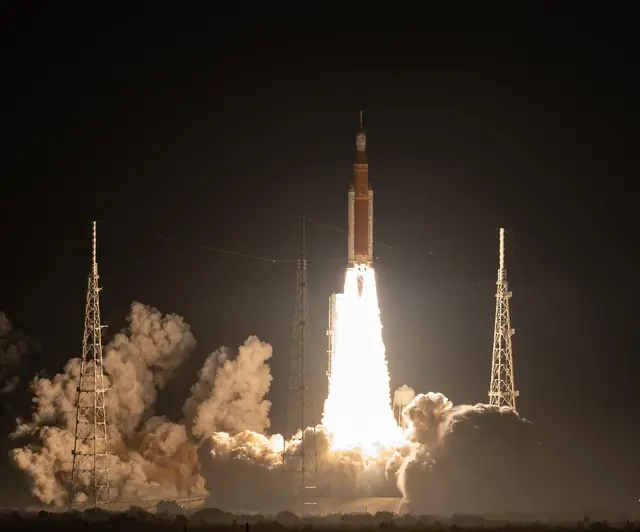
The problem
The SLS core stage is the backbone of NASA’s Artemis moon rocket: 212 feet tall, 27.6 feet across, carrying 537,000 gallons of liquid hydrogen and 196,000 gallons of liquid oxygen to feed four RS-25 engines. The hydrogen must stay at −423°F and the oxygen at −298°F, or it boils off as gas. The tank walls sit in humid coastal air on the pad and then take the heat of launch.
The insulation has to do four things at once: stop heat, keep air and moisture off the frozen metal so ice can’t form, stay bonded to curved aluminum through launch, and weigh as little as possible.
The material
| What | On the SLS core stage | Where it comes from |
|---|---|---|
| Insulation | Third-generation spray-on foam; NASA: “covered with an orange spray-on foam” | NASA, 2018 and reference page |
| Chemistry | Two liquids, an isocyanate and a polyol blend, that mix in the spray gun | NASA, 2018 |
| Cell structure | “All closed-cell materials… stronger and have greater resistance to heat flow and moisture” | NASA, 2016 |
| Thickness | About ½ to 2 inches overall; about 1.2 inches on the hydrogen tank | NASA, 2018 |
| Color | Sprayed light yellow; sunlight tans it orange. Left unpainted. | NASA, 2018 |
| Exception | The engine section uses cork under white paint instead of foam | NASASpaceflight.com, 2017 |
About 1.2 inches of foam on the hydrogen tank is the whole barrier between −423°F and the Florida air. For comparison, FoamGuard typically sprays two to three inches of closed-cell on a building’s walls and roof deck, where the job is a difference of 50 to 70 degrees on a winter day, not 500.
How it is applied
At NASA’s Michoud Assembly Facility in New Orleans, the hardware is primed for corrosion protection and to help the foam bond, then taped off. The large barrel sections are sprayed by a robotic system; the domes and complex shapes are sprayed by hand. Its newer blowing agent boils at about 65°F, so the components are kept cold until they reach the gun. Before any of it flew, NASA qualified its foams on hundreds of 24-by-24-inch test panels exposed to heating like launch.
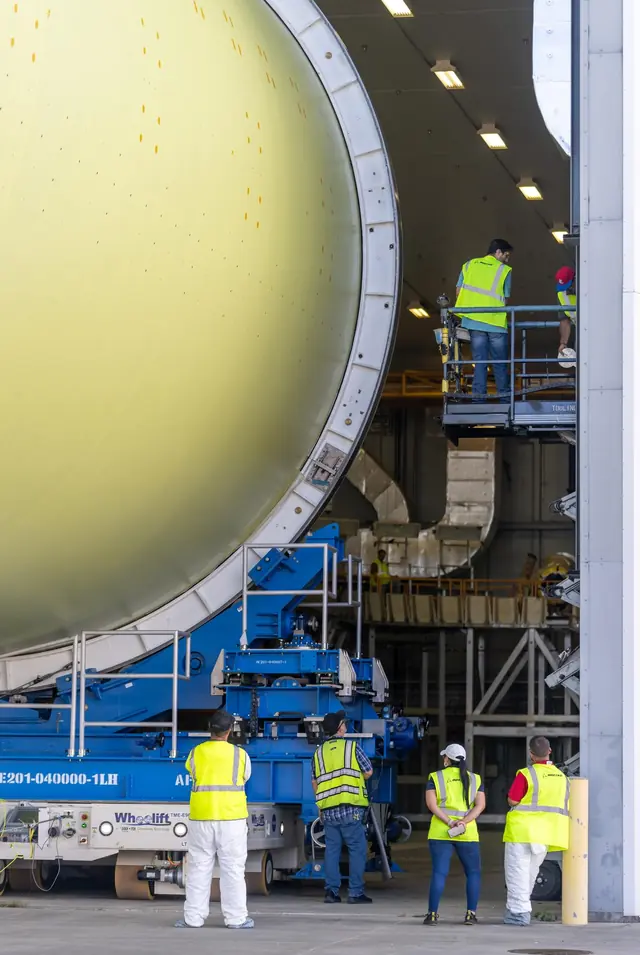
The lesson NASA learned the hard way
The SLS process carries the Space Shuttle’s experience. In 2003 a piece of foam broke off a hand-sprayed ramp on the Shuttle’s external tank during Columbia’s launch and struck the orbiter’s wing, and Columbia was lost on re-entry. NASA did not walk away from foam. It removed or redesigned the ramps where foam had come loose and tightened control of the application itself: sprayers practice on full-size mock-ups, every spray is recorded on video, and sprayers are certified on the process.
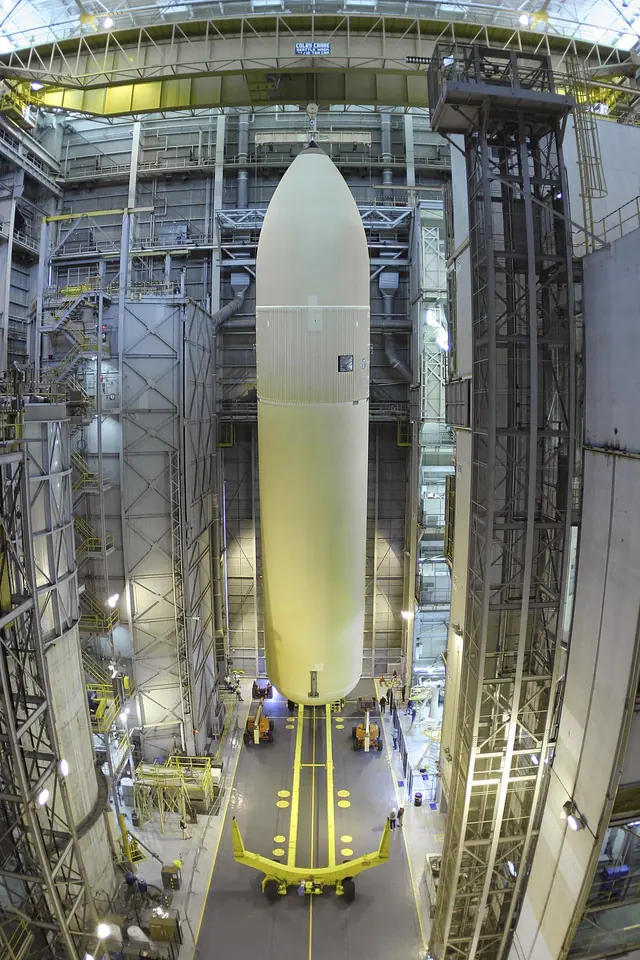
Spray foam was on every Shuttle external tank and is on the SLS core stage: applied right, it is the insulation NASA trusts with its propellant.
What it means for a building
- The chemistry is proven at the extreme. Sprayed, closed-cell foam is what engineers pick when insulation has to hold back hundreds of degrees with no seams and almost no weight. A wall or roof deck asks far less of it.
- The foam in a building is a cousin, not the same product. Building foam is formulated and tested for buildings and building codes. We spray Huntsman Heatlok HFO High Lift, a building product.
- The application is what you are really hiring. NASA certifies its sprayers and records every pass. On a FoamGuard job the installers are certified, the surface is measured before every lift, and every drum is lot-traced.
More on the rockets that use sprayed foam, from SLS to Japan’s H3, China’s Long March 5 and Europe’s Ariane 6: spray foam on rockets.
NASA is named here for facts only and does not endorse FoamGuard. FoamGuard’s building foam is not the foam used on SLS.
Sources
- Space Launch System Core Stage, NASA (reference page)
- Foam and Cork Insulation Protects Deep Space Rocket from Fire and Ice, NASA (June 20, 2018)
- NASA Tests New Insulation for SLS Rocket, NASA (September 2, 2016)
- 50 Years Ago: NASA Selects Contractor for Space Shuttle External Tank, NASA History (2023)
- Protecting SLS from fire and ice: TPS foam application proceeding at MAF, NASASpaceflight.com (December 2017)