
Short answer
"Closed-cell spray foam" names a family, not a product. The products at the top of it come with a third-party code evaluation report, a published processing window, a technical service line and a written warranty, and they are sold through the manufacturer's approved channel to contractors who have been through that manufacturer's training. The code reports say so in black and white: Huntsman's requires foam "applied by contractors authorized by Huntsman Building Solutions, LLC", and BASF's calls for "professional spray polyurethane foam installers approved by BASF Corporation" or by the SPFA. Foam sold with none of that behind it may be out of date, badly stored, or made to no published specification at all, and it is one place odor, adhesion and cracking problems start. You can check any product in five minutes.
Key points
- A tier-1 closed-cell foam carries an evaluation report (ICC-ES ESR or Intertek CCRR) that lists the codes it complies with, the thickness limits, the thermal barrier rule and the installer requirement.
- The installer requirement is in the report itself: ESR-4073 (Huntsman) requires authorized contractors; CCRR-0374 (BASF) requires installers approved by BASF or the SPFA. The report, not the sales rep, sets the rule.
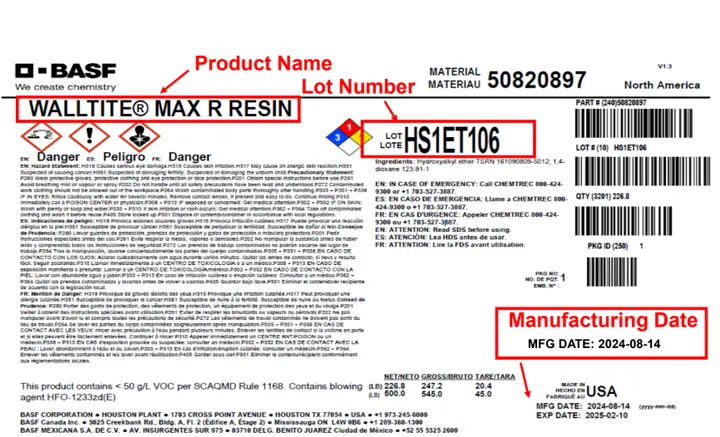
- The label is the proof on site. The reports require each container to show the maker's name, the product, the density, the fire indices and the date of manufacture, with the report number or the evaluation mark.
- The clocks are short: resin shelf life is about 3 to 6 months and isocyanate about 12, unopened and stored within the maker's temperature range. Foam past its date or stored hot is a different material.
- In Canada, certified installers and daily work sheets are required under the national application standard and the certification programs that run it. In the United States the manufacturers' authorization programs are what fill that gap, which is why they matter.
What "top-tier" means in writing
Spray foam used as building insulation has to show the code official it meets the code, and in the United States the usual proof is a third-party evaluation report: ICC-ES evaluation service reports (ESR) or Intertek code compliance research reports (CCRR). The report is where the real rules live, because it tells a building official what the product is, how it was tested, where it may be used, how thick, and under what conditions.
Two examples from the closed-cell foams FoamGuard is certified to install:
| What the report settles | ICC-ES ESR-4073, HEATLOK HFO High Lift (Huntsman) | Intertek CCRR-0374, WALLTITE Max and One (BASF) |
|---|---|---|
| Who may install it | "must be applied by contractors authorized by Huntsman Building Solutions, LLC" | "professional spray polyurethane foam installers approved by BASF Corporation" or approved by the SPFA |
| How it must be installed | "in accordance with the manufacturer's published installation instructions and this report"; on a conflict, "this report governs" | "in accordance with the manufacturer's published installation instructions"; on a conflict, the report governs |
| Pass thickness | up to 6½ inches per pass; next pass once the core is below 100°F | per the application guidelines |
| Thermal barrier | ½-inch gypsum wallboard or an approved equivalent | per the report's tables |
| What the label must show | the ICC-ES mark or the report number ICC-ES ESR-4073, the maker's name, product, density, flame-spread and smoke-developed indices, date of manufacture, R-values | the maker's name, product, density, fire indices, shelf life, manufacturing location, date of manufacture, the Intertek mark and the report number |
Read the first row again. The gate on who may spray these products is not a marketing preference. It is a condition of the code report the building official relies on.
Why the makers gate the product
Spray foam is manufactured on your wall by the installer, so the makers put the installer inside the specification. Huntsman's data sheet: "It is the sole responsibility of the applicator to process and apply Heatlok HFO High Lift within specification." BASF's application guidelines: "TO BE INSTALLED ONLY BY PROPERLY TRAINED CONTRACTORS", with training accepted only from verifiable sources such as BASF's own training center and the SPFA Professional Certification Program. Huntsman's public "how to buy" page says the company "only sells to qualified contractors."
Authorization brings things the foam alone can't: a processing window on paper (ratio, pressures, A, B and hose temperatures), a technical service department to call when a drum looks wrong, and a warranty that can be registered. Huntsman's closed-cell limited lifetime warranty, for example, applies to foam "installed by authorized contractors using trained applicators" and excludes "improper installation of Product (not in strict adherence with HBS's written instructions)". The warranty is tied to the authorization. Huntsman's older Heatlok Eco report, ESR-3198, says the same in fewer words: the foam "must be installed by factory-authorized applicators."
What foam from outside the chain looks like
Foam can also change hands outside the manufacturer's channel, or come from a maker with no evaluation report. The trouble is what you can't know about it.
- Age. Resin shelf life is about 3 to 6 months depending on the product and isocyanate about 12, unopened and stored in range. Spray foam shelf life and storage lists the published numbers by maker.
- Storage. Over the resin's storage ceiling the blowing agent starts to leave the drum; BASF warns that freezing can separate the resin and crystallize the A-side. A drum that rode through a summer in a trailer may no longer be the product on the data sheet.
- Specification. With no report there is no published pass thickness, no fire test, no thermal barrier rule, and no processing window to hold the installer to.
- Identity. The reports require the date of manufacture and the report number on every container. A drum without them has nothing to check.
These are some of the conditions behind the familiar complaints about spray foam: foam that smells for weeks, pulls away from the framing, cracks, or never reaches its rated R-value. The symptoms are described in how to spot bad spray foam and spray foam smell; the causes include unstable material and off-ratio processing.
How Canada handles it, and what that says about the US
In Canada, medium-density spray foam is installed under the national application standard CAN/ULC S705.2, and the certification organizations that run it require installers to be certified. CUFCA, one of them, puts it plainly: "Installers are required to be certified to apply the product," contractors "shall have at least one certified installer on each job site at all times," and "detailed daily work sheets providing a paper trail of testing results, site conditions, installers etc. are required to be completed," with mandatory inspections on large jobs.
Pennsylvania registers home improvement contractors as businesses under the Home Improvement Consumer Protection Act; the registration is not a trade certification (a summary of a public statute, not legal advice). The installer standards that apply here are the ones the manufacturers write into their authorization programs and the code reports, which is why "which product, and are you authorized to install it?" is the most useful question a buyer can ask.
Check any product in five minutes
- Get the exact product name from the quote. "Closed-cell foam" is not an answer.
- Search the product name with "technical data sheet". Note the ratio, pressure and temperature window and the shelf life.
- Search it with "ESR" or "CCRR". Open the report and read the installation section: who may install it, how thick per pass, and the thermal barrier rule.
- Ask the contractor whether they are authorized or approved by that maker and whether the product warranty will be registered in your name.
- On install day, read the drum labels: product, date of manufacture, lot number, report number. Ask that the lot numbers go into your project file.
The contractor guide's 15 red flags cover the rest of the paperwork, and how to read a spray foam quote shows where the product name belongs on the quote.
FoamGuard sprays products from both makers in the table above, is a certified installer for each, records the drum lot numbers on every job, and registers the manufacturer's warranty in your name. Want a number for your own project? Price My Project or call (814) 208-3478.
Read next: Spray Foam as an Add-On Service: What the Material, the Equipment and the Warranty Demand · Spray Foam Shelf Life and How Drums Should Be Stored · Why Spray Foam Equipment Can't Sit Idle: ISO Crystallization, Purging and the Weekly Clock.
FAQ
Is all closed-cell spray foam the same?
No. Products differ in their blowing agent, density, R-value per inch, vapor permeance, fire test results, shelf life and processing window. A code evaluation report is the document that pins those down for a specific product.
Can anyone buy professional spray foam?
Huntsman says it sells only to qualified contractors, and both makers' code reports require the foam to be applied by installers they, or the SPFA, have approved. However a drum changes hands, the report's installer requirement still applies.
Does the brand of spray foam matter?
The report behind it matters more than the name. A product with an ICC-ES or Intertek report, a published data sheet and a registered warranty can be checked; one without them can't.
How do I know which foam was sprayed in my house?
From the drum labels and the lot numbers, which belong in your project file along with the photos and the foam type. If the installer can't name the product, nothing downstream can be checked.
Sources
- ICC-ES ESR-4073: Heatlok HFO High Lift Spray Foam Insulation (reissued August 2026)
- Intertek CCRR-0374: BASF WALLTITE Max and One Spray-Applied Polyurethane Foam Insulations (rev. Feb. 19, 2025)
- ICC-ES ESR-3198: Heatlok Eco Series Spray-Applied Polyurethane Insulation (reissued April 2023)
- Huntsman Building Solutions: HEATLOK HFO High Lift Technical Data Sheet (rev. 11.25.24)
- Huntsman Building Solutions: How to buy (US)
- Huntsman Building Solutions: Closed-Cell Spray Foam Limited Lifetime Warranty (rev. 04.08.21)
- BASF: WALLTITE Series HFO Spray Foam Insulation Application Guidelines (Feb. 9, 2023)
- CUFCA: Quality Assurance Program Overview
- American Chemistry Council: Spray Foam Quality Assurance in Canada
- Spray Polyurethane Foam Alliance: Individual Certification Programs
- 73 P.S. § 517.7, Home Improvement Consumer Protection Act: home improvement contracts (FindLaw)