
Short answer
Spray foam pulls away from studs when the foam was weakened as it was made: a pass sprayed thicker than the product allows overheats and leaves a soft center that contracts, framing above 19% moisture or below the product's minimum temperature won't hold the bond, and off-ratio foam lacks the strength to stay put. Correctly sprayed closed-cell foam stays bonded. A gap is found by looking and pressing before drywall, then cut back to sound foam and resprayed in thin passes.
Key points
- Excess heat in thick passes is a leading cause: a closed-cell sample sprayed more than 4 inches in one lift came out under 10 psi in the middle and shrank severely within a day.
- Gaps can open within hours, days or weeks. Found after drywall, they are expensive to fix, so check before the walls are closed.
- Wood above 19% moisture gives poor cell structure and cracks between foam and framing as the wood dries; surfaces below about 55°F or the product minimum weaken adhesion.
- Pass limits differ by product: BASF's WALLTITE line runs from 2 to 4 inches per pass depending on the formula; one Huntsman closed-cell sheet allows 2 inches per pass and 8 inches in 24 hours.
- The repair: cut the failed foam back at about 45° to sound foam, then respray in thin passes. JLC's troubleshooting guide puts a typical repair at 5 to 15% of the foam.
What pull-away looks like
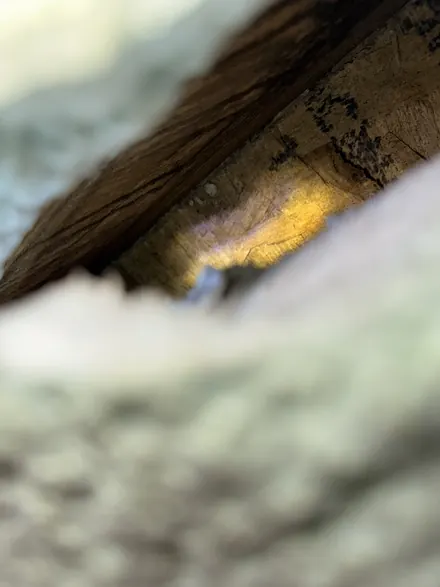
Look along the edges of each stud bay and rafter bay. Good closed-cell foam meets the wood with no visible line and does not move when you press beside it. Pull-away shows as a dark line or an open gap between the foam and the framing, sometimes with the foam's face curving back from the wood in a shallow horseshoe. Press near the edge: foam that has let go feels hollow or flexes. In a roof, look where the foam meets each rafter and the top plate.
Spray foam consultant Mason Knowles notes the gap can appear within hours, days or weeks of the job. That timing matters, because the cheapest time to find it is before drywall. Once the walls are closed, a callback for shrinkage is an expensive repair.
Why spray foam shrinks
Closed-cell foam is made on the wall by a chemical reaction that gives off heat. Everything that weakens the foam as it forms, or weakens its grip on the surface, shows up later as shrinkage.
Passes sprayed too thick
Knowles reports a growing number of these cases. Heat builds inside a thick pass; the center can come out discolored, with elongated cells and low strength. In one documented case, closed-cell foam sprayed more than 4 inches in a single lift measured under 10 psi in the lower center, against the 20 to 30 psi typical of 2-pound foam, and shrank severely within a day of being cut out. The fix is in the data sheet: each product sets a maximum pass thickness and a cooling time. BASF's WALLTITE products allow from 2 to 4 inches per pass depending on the formula, and BASF requires any pass sprayed over the maximum to be removed. One Huntsman closed-cell data sheet sets 2 inches per pass, a 30-minute cooling time before going over 4 inches, and 8 inches in 24 hours, and warns that excessive thickness in one application can cause the foam to self-ignite hours later.
Wet framing
Moisture acts as an extra blowing agent. Foam sprayed on wood above 19% moisture content can form a poor cell structure and a weak bond, then crack away from the framing as the wood dries. The makers' data sheets set the same limit: wood below 19%. A pin moisture meter answers the question in seconds.
Cold surfaces and the dew point
Below about 55°F, or the product's own minimum, the foam can form a hard, shellac-like skin against the surface and lose adhesion. Spraying within 5°F of the dew point gives low-density foam with too many open cells. Winter-grade products exist for cold surfaces, but each still has a floor; spray foam in winter lists them.
Off-ratio foam and bad chemicals
The two sides must meet at 1:1 by volume, within 2%. Drums stored outside their range, expired or contaminated material, or failing pumps can push the mix off ratio, and off-ratio foam may not have the strength to hold its shape. Off-ratio spray foam shows the signs.
The product itself
Closed-cell foams are tested for dimensional stability under ASTM D2126, and the published numbers differ. In the same heat and humidity test, one Huntsman data sheet lists a 3.7% volume change, while another brand's sheet allows up to 9.2%. Not all spray foam is the same; who can buy the top-tier products explains why.
Lumber that moves
Framing lumber also shrinks and swells with the seasons. Building scientist Allison Bailes has noted that a hairline separation in cold weather can come from the wood moving rather than the foam. A hairline that comes and goes with the seasons is a different thing from a gap you can slide a card into.
Causes at a glance
| Cause | What you may see | How it is prevented |
|---|---|---|
| Pass too thick | Horseshoe-shaped shrinkage, soft or discolored center, scorching | Passes within the product's maximum, cooling time between them |
| Wet framing | Cracks between foam and wood as the wood dries | Moisture readings; wood below 19% before spraying |
| Cold surface | Hard skin at the surface, poor adhesion, foam lifting | Surface temperature within the product's range, checked through the day |
| Off-ratio mix | Brittle, soft, sticky or off-color foam | Ratio and pressures watched; drums in range and in date |
| Lumber movement | Hairline that opens in winter and closes in summer | Dry framing before spraying; seal the hairline if it stays open |
How to check before drywall
- Walk every bay with a flashlight held flat to the wall; a shadow line at a stud means a gap.
- Press the foam beside each stud and rafter. It should feel solid and not flex.
- On a cold or hot day, a thermal camera shows gaps as a cold or warm line along the framing.
- Ask what the passes were and how long each cooled. The installer should know.
- If a section looks wrong, ask for a core: cut from the foam, it should be evenly colored and firm through its depth.
How pull-away is repaired
Caulk or a can of foam in the gap treats the symptom. The repair the industry describes is to cut the failed foam back, at about a 45° angle, to foam that is still bonded and sound, then respray in thin passes until the full thickness is back. JLC's troubleshooting guide puts a typical repair at 5 to 15% of the foam. If the cause was wet wood or a cold surface, it gets fixed first, or the new foam will fail the same way.
Have the repair recorded with photos, and confirm the warranty covers it. What happens if a spray foam defect shows up after the job explains how FoamGuard handles it under its written warranty, and how to spot bad spray foam covers the other visual checks.
At FoamGuard, off-color foam is stopped, cut out and resprayed only once the cause is fixed, and every job ends with photos of every corner and a thermal-camera scan, so a gap shows up before the customer ever sees it. Price My Project or call (814) 208-3478.
Read next: How to Spot Bad Spray Foam: A Homeowner's Visual Guide · Off-Ratio Spray Foam: How to Spot It and What to Do · Spray Foam Insulation Complaints: The 5 Most Common and How to Avoid Them.
FAQ
Is it normal for spray foam to pull away from studs?
No. Correctly sprayed closed-cell foam stays bonded to the framing. A hairline that opens in cold weather can come from the lumber shrinking; a gap you can see into points to a pass sprayed too thick, wet or cold framing, or off-ratio foam.
Can you fill spray foam gaps with canned foam?
Canned foam or caulk can seal a small gap, but it doesn't fix foam that failed. The accepted repair is to cut the failed foam back to sound foam and respray it in thin passes, after fixing whatever caused it.
How long after spraying can foam shrink?
Gaps can appear within hours, days or weeks of installation, according to spray foam consultant Mason Knowles. Check the foam before the walls are closed.
What is the maximum pass thickness for closed-cell spray foam?
It depends on the product. BASF's WALLTITE products allow from 2 to 4 inches per pass depending on the formula; one Huntsman closed-cell data sheet allows 2 inches per pass and 8 inches in 24 hours. The data sheet for the exact product is the rule.
Does open-cell spray foam shrink?
Open-cell foam is softer and more flexible and is sprayed to fill the cavity, then trimmed flush. Shrinkage complaints center on closed-cell foam, which is rigid and sprayed in measured passes.
Sources
- Spray Foam Insider: Thick Foam Lifts and Shrinking Foam (Mason Knowles)
- JLC: Troubleshooting Spray-Foam Insulation (Mason Knowles)
- BASF: WALLTITE Series HFO Closed-cell Application Guidelines (Aug. 27, 2024)
- Huntsman Building Solutions: Heatlok Soya HFO Technical Data Sheet (pass limits, substrate moisture)
- Huntsman Building Solutions: Heatlok Soya HFO Technical Data Sheet (self-ignition warning)
- Huntsman Building Solutions: Heatlok HFO Pro Technical Data Sheet (ASTM D2126)
- Central Urethane: X-PRESS Seal 200 Technical Data Sheet (ASTM D2126)
- Energy Vanguard: 4 Pitfalls of Spray Foam Insulation (Allison Bailes)
- Spray Foam Magazine Q&A forum: Foam separating from studs