
Short answer
Use board where the surface is big, flat and continuous, like the outside of a wall or under a slab. Use spray foam where the surface is irregular, crowded with framing or penetrations, or has to be air-sealed in place, like rim joists, roof decks and metal buildings. By their labels, EPS runs R-3.6 to R-4.2 per inch, XPS R-5, polyiso about R-6 and HFO closed-cell spray foam about R-6.3 to R-7.4. Board only seals air if every seam and edge is taped or foamed; spray foam seals as it goes on.
Key points
- Labeled R per inch at a 75°F mean: EPS 3.6–4.2, XPS 5.0, polyiso about 6, HFO closed-cell spray foam 6.3–7.4, open-cell 3.7–4.1.
- Cold matters: polystyrene gains R-value as it gets colder; many polyiso boards lose some below about 50°F.
- Board is an air barrier only when its seams and edges are sealed. Spray foam bonds and seals as it is applied.
- Board wins outside the framing, under slabs and on big flat walls.
- Spray foam wins at rim joists, roof decks, metal buildings, irregular framing and around penetrations.
- Inside a home, both are foam plastics and both need a thermal barrier such as ½-inch drywall.
The three boards, and what their labels mean
DOE lists polystyrene, polyisocyanurate and polyurethane as the usual materials for foam board. It credits board with a high insulating value for relatively little thickness, and notes that when it runs continuously over studs or joists it blocks the heat that would otherwise short-circuit through the framing.
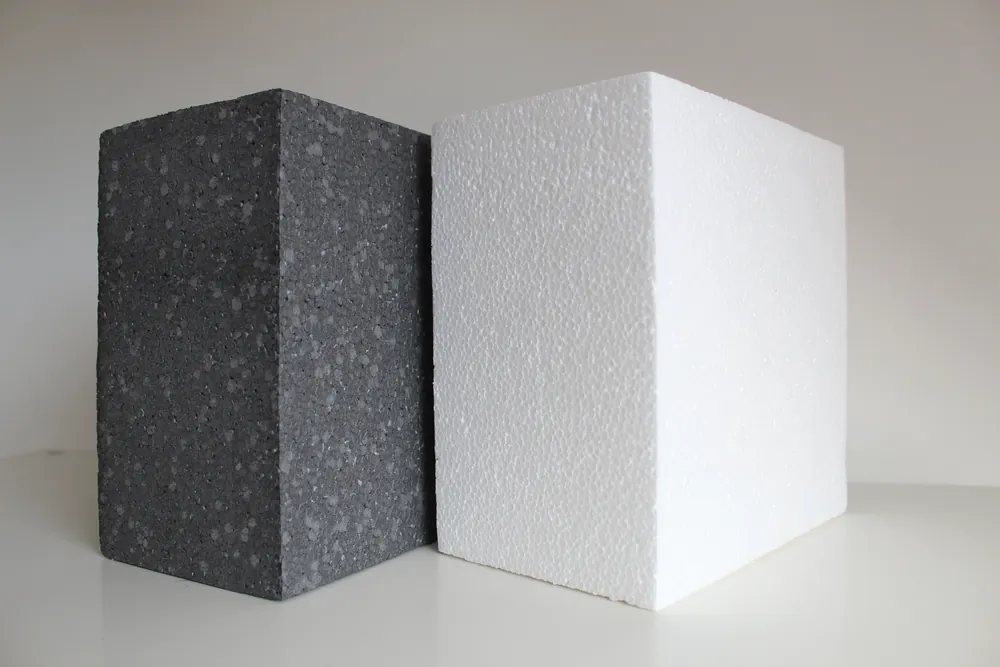

- EPS (expanded polystyrene) is the white bead board, also made in a graphite-gray version. ASTM C578 sorts it into types by density; the common building types are rated R-3.6 (Type I), R-4.0 (Type II) and R-4.2 (Type IX) per inch at a 75°F mean temperature.
- XPS (extruded polystyrene) is the smooth pink, blue or green board, rated R-5.0 per inch in its common types (X and IV).
- Polyiso (polyisocyanurate) is usually foil-faced and carries the highest label, about R-6 per inch, published as a long-term thermal resistance (LTTR) value. It is rated at 75°F too, and its standard, ASTM C1289, requires values at 40°F and 110°F to be available on request.
Those labels describe the board alone, in a lab, at a mild temperature. Two things change the picture in a real Western Pennsylvania wall: cold weather and air leaks at the seams.
R-value per inch, side by side
| Material | Labeled R per inch | In cold weather | Air barrier? | Typical uses |
|---|---|---|---|---|
| EPS board (Types I, II, IX) | 3.6–4.2 | R-value rises as it gets colder | Only with every seam and edge sealed | Under slabs, outside walls and foundations |
| XPS board (Types X, IV) | 5.0 | R-value rises as it gets colder | Only with every seam and edge sealed | Under slabs, foundation walls |
| Polyiso board, foil-faced | About 6 (LTTR) | Many boards lose R-value below about a 50°F mean | Only with taped seams | Roofs, continuous insulation on walls |
| Closed-cell spray foam (HFO) | 6.3–7.4 (aged) | Rated at 75°F, like the boards | Yes, at the thickness in its code report | Rim joists, roof decks, metal buildings, irregular framing |
| Open-cell spray foam | 3.7–4.1 | Rated at 75°F | Seals the cavity it fills | Interior walls and roof decks where vapor control is handled separately |
Spray foam values are from current manufacturer data sheets; spray foam R-value per inch has the product-by-product table.
Air sealing: where board needs help
A sheet of foam board stops air going through it. The leaks happen around it: at the seams between boards, at the edges where board meets framing, and wherever a pipe or wire passes through. DOE's weatherization job aid for rim joists shows the fix: cut the board to fit, push it tight against the rim joist, and seal every edge with one-part foam, caulk or mastic.
That works, and it is a good do-it-yourself method. It is also slow and depends on every edge being done right: a basement with 40 joist bays has 160 edges to seal at the rim alone. Spray foam does the same job in one step, because it bonds to the rim joist, the sill plate and the subfloor and fills the cracks between them as it goes. Building Science Corporation's rim-joist detail for Building America makes the same point: to work as an air barrier, the foam has to connect from the foundation wall, up the rim joist and to the floor sheathing.
Cold climates: the polyiso catch
Most insulation gets a little better as it gets colder, and polystyrene does: the EPS industry's R-value booklet and Owens Corning's XPS data both show R-values rising as the mean temperature drops below 75°F. Many polyiso boards go the other way. Green Building Advisor's reporting on cold-weather testing found polyiso performing worse below a mean temperature of about 50°F, as the blowing agents trapped in its cells begin to condense.
For a board on the outside of a wall in an Erie January, that matters: the label may say R-6 while the board on the cold side of the wall delivers less. Some manufacturers now make polyiso with blowing agents that hold up better in the cold, so for exterior use here it is worth asking for the 40°F value the standard makes available.
Where board wins
- Continuous insulation outside the framing. Board over the sheathing covers the studs too, which is the thermal short circuit DOE points to.
- Under concrete slabs. EPS and XPS are sold by compressive strength (15 and 25 psi in the most common building types), which is what a slab sitting on them needs.
- Big, flat, open surfaces where the seams are few and easy to tape, like a smooth poured basement wall.
Where spray foam wins
- Rim joists and sills, where the air leaks are in the cracks between pieces of wood (see rim joist spray foam).
- Irregular framing and older houses. DOE describes sprayed foam as good for irregularly shaped areas and around obstructions, filling even the smallest cavities.
- Roof decks for sealed attics (see sealed attic spray foam).
- Metal buildings and pole barns, where foam bonded to the steel keeps moist air off the cold metal (see why a pole barn roof drips).
- Anywhere crowded with pipes, wires and ducts, where every penetration through a board is one more edge to seal.
On many jobs the two aren't rivals: board outside the framing or under the slab, spray foam at the rim joists and the tricky spots.
Both need a thermal barrier inside
Board and spray foam are both foam plastics, and the residential code (IRC Section R316) treats them alike inside a home: where they face living space they have to be covered by a 15-minute thermal barrier such as ½-inch drywall, with exceptions for some attics, crawlspaces and rim joists. The details are in thermal barrier vs. ignition barrier.
Want a number for your own project? Price My Project, book a free visit or call (814) 208-3478.
Read next: Spray Foam R-Value per Inch: Open vs Closed Cell · Basement Wall Insulation in Zone 5: Spray Foam vs Board · Spray Foam vs Fiberglass vs Cellulose in Zone 5.
FAQ
Is foam board or spray foam better for a basement wall?
Both work when the foam is continuous and every seam is sealed. Board suits a smooth poured wall with few penetrations; spray foam suits rough block or stone and walls crowded with pipes and wires. The rim joist above is usually easiest with spray foam.
Why does polyiso lose R-value in the cold?
The blowing agents trapped in its cells start to condense at low temperatures, as a Building Science Corporation researcher explained to Green Building Advisor. Some newer boards use blowing agents that hold up better.
Do I need to tape the seams of foam board?
If the board is meant to stop air, yes. DOE's rim joist job aid has every edge sealed with one-part foam, caulk or mastic; on walls, the seams are taped.
Does foam board need drywall over it?
Inside a home, yes, just like spray foam. The residential code requires a thermal barrier such as ½-inch drywall over foam plastic facing living space, with exceptions for some attics, crawlspaces and rim joists.
Sources
- U.S. DOE Energy Saver: Types of Insulation
- EPS Industry Alliance: ASTM C578 EPS Thermal Insulation Performance Requirements
- EPS Industry Alliance: R-Value booklet (EPS and XPS, ASTM C578 Types II, IX, X, IV)
- GAF: Polyiso Insulation Explained (LTTR and ASTM C1289)
- Green Building Advisor: Cold-Weather Performance of Polyisocyanurate
- Green Building Advisor Q&A: Polyiso Losing R-Value in Cold Climates
- Owens Corning: XPS and polyiso R-value at lower temperatures (technical document)
- U.S. DOE Weatherization Job Aid: Insulate Rim Joist (2024)
- Building Science Corporation for DOE Building America: Information Sheet 408, Critical Seal (Spray Foam at Rim Joist)
- Huntsman Building Solutions: HEATLOK HFO High Lift Technical Data Sheet (rev. 11.25.24)
- BASF: WALLTITE LWP closed-cell HFO Technical Data Sheet