
Short answer
Your bill is the price per kilowatt-hour times the kilowatt-hours you use, and in Pennsylvania the price has climbed fast. The average residential rate went from 17.77¢ in 2024 to 19.29¢ in 2025, and was 21.77¢ in August 2026 against 19.93¢ a year earlier, driven by regional capacity prices that rose about ninefold in one auction. Penelec's default generation price is up 25% since May 2025. You can shop the price; the lasting fix is using fewer kilowatt-hours for heating and cooling.
Key points
- Pennsylvania's average residential electricity price was 19.29¢/kWh in 2025, against 17.23¢ nationally, and 21.77¢ in August 2026 (preliminary).
- The PJM grid's capacity price went from $28.92 per megawatt-day for 2024/25 to $269.92 for 2025/26, then to the price cap of $329.17 for 2026/27. PJM and its market monitor point to data center demand.
- Penelec's price to compare, the default generation price in the Erie area, rose from 10.474¢ to 13.142¢ between May 2025 and June 2026.
- Air conditioning (19%), space heating (12%) and water heating (12%) are the biggest electric uses in U.S. homes; in an electrically heated house, heating dominates the winter bill.
- What lowers it for good: seal and insulate, replace resistance heat with a heat pump sized to the tighter house, and use the utility's free home energy assessment and rebates.
The two numbers on every bill
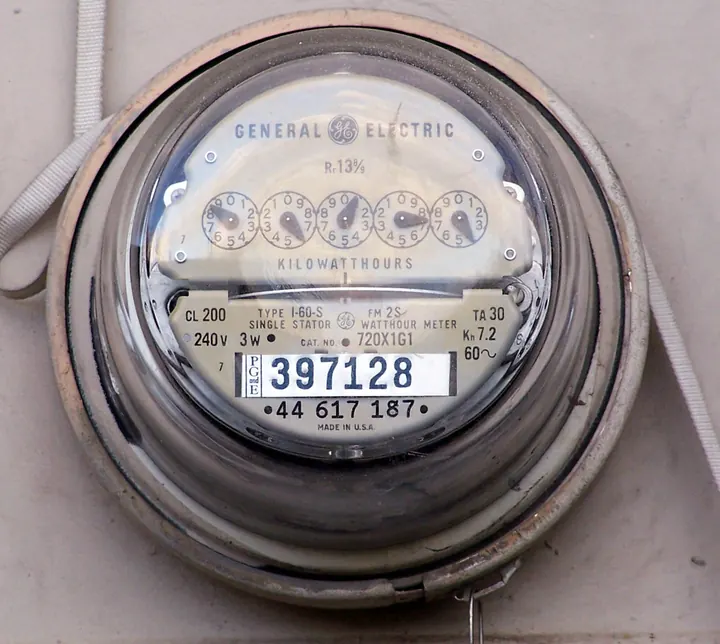
Every electric bill is a rate times usage. The rate has two halves in Pennsylvania: generation (the power itself, from your utility's default service or a supplier you choose) and delivery (the wires, charged by the utility). The Public Utility Commission says generation charges can be "roughly 50% or more of a total electric bill."
A bill that jumped while your habits didn't is a rate problem. A bill that's high every winter or every July is a usage problem. Most Western PA homes have both right now.

Why the price went up
The capacity market. PJM, the grid operator for Pennsylvania, all or part of 12 other states and Washington, D.C., holds auctions to pay power plants to be available in future years. The cost flows into every customer's generation price.
PJM said the 2025/26 jump came from "a large number of generator retirements, combined with increased electricity demand." For 2026/27, peak demand rose more than 5,400 megawatts, "driven largely by data center expansion," and PJM's independent market monitor called data center load growth "the primary reason" for the high prices. A FERC-approved price collar, set in coordination with the governors of PJM's 13 states (Governor Shapiro announced the agreement in January 2025), now holds the auction price near $325 to $333 per MW-day; the last three auctions all cleared at that cap.
The price to compare. Utilities reset their default generation price every June 1 and December 1 based on wholesale costs. In Western PA, June 1, 2026 brought:
| Utility | Price to compare before | From June 1, 2026 | Change |
|---|---|---|---|
| Penelec (Erie and much of NW PA) | 11.747¢ | 13.142¢ | +11.9% |
| West Penn Power | 10.947¢ | 12.075¢ | +10.3% |
| Penn Power | 12.606¢ | 13.477¢ | +6.9% |
| Duquesne Light (Pittsburgh) | 13.75¢ | 14.14¢ | +2.8% |
For Penelec customers that was the third increase in a row, after June and December 2025.
Where the kilowatt-hours go
In U.S. homes, air conditioning is the largest electric use at about 19%, followed by space heating and water heating at about 12% each, then refrigerators and lighting. Those are averages across houses heated with gas, oil and electricity.
In Pennsylvania, about one household in four heats with electricity. In those homes, heat dominates the winter bills, and a heat pump that falls back on electric resistance strips in a cold snap uses far more. In gas-heated homes, insulation's biggest savings show on the gas bill, and the electric bill sees the air conditioner and the furnace blower.
What actually lowers the bill
- Check your generation price. Compare your supplier's rate with the utility's price to compare; the PUC's PAPowerSwitch site lists offers. Read the contract for variable rates and fees.
- Seal and insulate. ENERGY STAR's modeling puts the average savings from air sealing and insulating at 16% of heating and cooling costs in climate zone 5 (12% of the whole energy bill), with a 25% cut in air leakage. Rim joists and the attic floor are two of the places older Western PA houses leak; closed-cell spray foam seals and insulates them in one step.
- Replace resistance heat with a heat pump. The DOE says a heat pump can cut the electricity used for heating by up to 75% compared with baseboard or electric furnace heat. Insulate first: the heating load drops, and so does the size and price of the heat pump. Our Erie load calculation shows about a quarter less load after a typical retrofit.
- Turn the thermostat back. The DOE's Energy Saver guide: up to 10% a year on heating and cooling by setting back 7 to 10°F for 8 hours a day.
- Use the free assessment and the rebates. FirstEnergy's Pennsylvania utilities (Penelec, West Penn Power, Penn Power, Met-Ed) offer a no-cost home energy assessment that includes air leak testing, and rebates of $750 to $1,000 for an air-source heat pump, $1,500 for replacing radiant electric heat with a heat pump, and $500 for a heat pump water heater (2026 forms). The 2026 HVAC rebate form covers equipment; ask the assessment program which insulation or air-sealing incentives apply.
Savings vary. Find out why in the seller's fact sheet on R-values. Higher R-values mean greater insulating power.
Rebates and help in 2026
- Federal tax credit: the 25C credit for insulation and air sealing covered improvements made through December 31, 2025, according to the IRS. Nothing replaces it for 2026 work. See spray foam tax credits and rebates in PA.
- Pennsylvania's federal home energy rebates (HOMES and HEAR): as of September 2026, the state DEP was still awaiting DOE approval to launch them.
- Act 129: the state's utility efficiency program entered Phase V on June 1, 2026, running to May 31, 2031; that is what funds the utility rebates above.
- Bill help: LIHEAP's 2026–2027 season opens November 2, 2026. The state's Weatherization Assistance Program provides blower-door-guided air sealing and insulation for households at or below 200% of the federal poverty level.
Want to see what sealing and insulating your house would cost? Try the insulation cost calculator, Price My Project or call (814) 208-3478.
FAQ
Why did my electric bill go up in June 2026?
Pennsylvania utilities reset their default generation price on June 1. Penelec's rose 11.9% to 13.142¢/kWh, West Penn Power's 10.3%, after PJM capacity prices climbed in 2025 and 2026.
Why is my electric bill so high in winter?
Usually electric heat. About one Pennsylvania household in four heats with electricity, and resistance heat or a heat pump's backup strips use a lot of power in cold weather; air sealing and insulation cut how much heat the house needs.
Will insulation lower my electric bill?
It lowers the energy used for heating and cooling. In an electrically heated house that shows on the electric bill; in a gas-heated house most of it shows on the gas bill, with some on the electric bill in summer.
Should I switch electric suppliers?
Compare the supplier's offer with your utility's price to compare and read the contract for variable rates and fees. Switching changes the generation price, not how much electricity you use.
Sources
- Electric Power Annual, Table 2.10: average price to ultimate customers by state, U.S. EIA (2026)
- Electric Power Monthly, Table 5.6.A: average price by state, U.S. EIA (October 2026)
- PJM capacity auction results for 2025/2026 (July 30, 2024)
- PJM capacity auction results for 2026/2027 (July 22, 2025)
- PJM capacity auction results for 2027/2028 (December 17, 2025)
- PJM capacity auction results for 2028/2029 (July 14, 2026)
- Monitoring Analytics, analysis of the 2026/2027 base residual auction (October 1, 2025)
- PA PUC: summer electric price changes begin today (June 1, 2026)
- PA PUC: June 1 electric price changes and higher summer energy costs (May 20, 2026)
- PA PUC: December 1 electric price changes (November 24, 2025)
- Electricity use in homes, U.S. EIA
- Pennsylvania state profile and energy estimates (home heating fuels), U.S. EIA
- PA PUC: June 1, 2025 electric price changes (May 21, 2025)
- Governor Shapiro's agreement with PJM on the capacity price cap (January 28, 2025)
- Weatherization Assistance Program, PA DCED
- ENERGY STAR: Methodology for estimated energy savings from air sealing and insulating
- Heat pump systems, U.S. DOE Energy Saver
- FirstEnergy Pennsylvania residential HVAC rebate application (2026)
- FirstEnergy Pennsylvania home energy assessments
- PA PUC approves Act 129 Phase V (June 18, 2025)
- Pennsylvania DEP: Inflation Reduction Act home energy rebates
- IRS: Energy efficient home improvement credit
- Pennsylvania LIHEAP