
Short answer
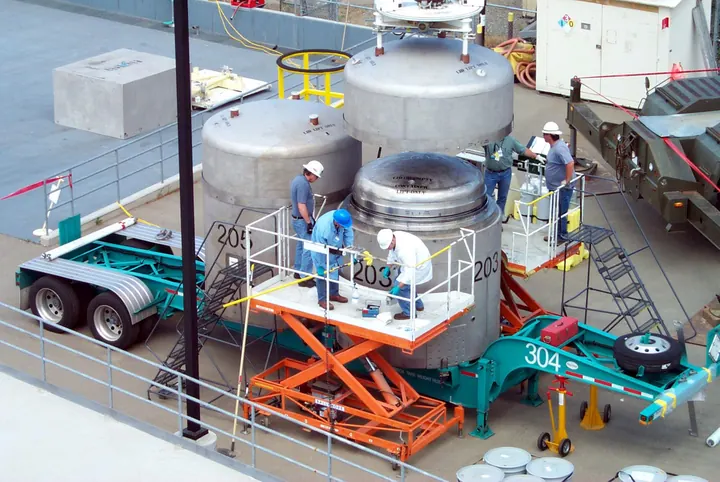
The TRUPACT-II, the steel cask the U.S. Department of Energy uses to truck transuranic nuclear waste to its Waste Isolation Pilot Plant in New Mexico, is built around a 10-inch layer of polyurethane foam between stainless steel shells. The foam cushions and insulates both of its sealed containment vessels, and the package has to survive a 30-foot drop onto an unyielding surface and a fire at 1,475°F for 30 minutes. Rigid closed-cell foam was chosen for both jobs at once.
Key points
- The TRUPACT-II is a cylinder about 94 inches across and 122 inches tall: two unvented 1/4-inch stainless steel containment vessels, one inside the other, wrapped in a 10-inch layer of polyurethane foam and a 1/4- to 3/8-inch stainless steel outer shell, per its Nuclear Regulatory Commission certificate.
- A 1991 DOE paper on the package calls the rigid closed-cell foam "an excellent impact-energy absorber."
- Required tests include a 30-foot drop onto a flat, unyielding surface and 30 minutes in a fire at 1,475°F.
- The larger TRUPACT-III also uses inner and outer stainless steel plates with polyurethane foam "to protect against potential punctures and fire danger."
- The cask foam is a factory-poured, encased cousin of building spray foam. In a building, foam still needs a code thermal barrier.
What the TRUPACT-II carries
The Waste Isolation Pilot Plant (WIPP), run by the U.S. Department of Energy out of Carlsbad, New Mexico, is where the country sends transuranic (TRU) radioactive waste for permanent disposal. The waste arrives by truck in four shipping casks approved by the Nuclear Regulatory Commission; three of them, the TRUPACT-II, the HalfPACT and the TRUPACT-III, carry contact-handled waste.
A shipping package like this has one job: keep its contents contained through any accident a truck could plausibly have, including a crash followed by a fuel fire.

How the cask is built
The Nuclear Regulatory Commission's certificate of compliance describes the package as a right circular cylinder about 94 inches in diameter and 122 inches tall, built in layers, from the inside out:
| Layer | Material | Thickness |
|---|---|---|
| Inner containment vessel | Stainless steel, unvented | 1/4 in. |
| Outer containment vessel | Stainless steel, unvented | 1/4 in. |
| Energy absorber and insulation | Polyurethane foam | 10 in. |
| Outer shell | Stainless steel | 1/4 to 3/8 in. |
The foam surrounds the outer containment vessel. A 1991 DOE paper on the WIPP transportation system describes it as "rigid closed-cell polyurethane foam approximately 25 cm thick" that "cushions and insulates both containment vessels," and calls it "an excellent impact-energy absorber."
Why foam, and what it has to survive
The DOE's WIPP transportation fact sheet lists the tests a package must pass: a free drop, a puncture test, a burn test and an immersion test. The drop is "from 30 feet onto a flat, unyielding surface," and the burn test means "subjecting it to a temperature of 1,475 degrees Fahrenheit for 30 minutes."
Rigid foam answers both:
- Impact. In a drop, the foam crushes progressively and spreads the load, so the inner vessel decelerates over inches instead of slamming into the outer shell. That is why the foam layer is thick.
- Fire. Polyurethane foam conducts heat poorly. Behind a steel skin, it slows the heat reaching the inner vessel during a fire long enough for the test to end with the contents intact.
- Weight. Foam does both jobs while staying light, which matters for a package that rides on a truck.
The TRUPACT-III, a large rectangular cask, follows the same idea: the DOE fact sheet describes it as "inner and outer stainless steel plates and polyurethane foam to protect against potential punctures and fire danger."
How it compares with building spray foam
The cask's foam is the same chemical family as closed-cell spray foam, rigid polyurethane, but it is formulated for the job, poured into a steel shell and sealed inside it. Building foam is sprayed on site, about 2 lb per cubic foot, and is exposed to the room unless something covers it.
That difference matters for fire. Building spray foam is a combustible foam plastic; the code requires a thermal barrier, usually 1/2-inch gypsum board, between it and occupied space. In the cask, the steel outer shell plays a similar role. See is spray foam flammable?
What carries over is the material's character: rigid, closed-cell, light, a poor conductor of heat, and tough. The same family insulates LNG tankers at −261°F (LNG carriers) and NASA's rocket tanks at −423°F (spray foam on rockets).
Want closed-cell foam in your own walls? Price My Project or call (814) 208-3478.
FAQ
What is inside a TRUPACT-II?
Drums or boxes of transuranic waste inside two nested, unvented stainless steel containment vessels, surrounded by 10 inches of polyurethane foam and a stainless steel outer shell.
Why is there foam in a nuclear waste cask?
It absorbs impact in a crash and insulates the inner vessel during a fire. The package has to pass a 30-foot drop and 30 minutes at 1,475°F.
Is cask foam the same as spray foam insulation?
It is the same chemical family, rigid closed-cell polyurethane, but formulated for the cask and sealed inside steel; building spray foam is sprayed on site and covered by a code thermal barrier.