
Short answer
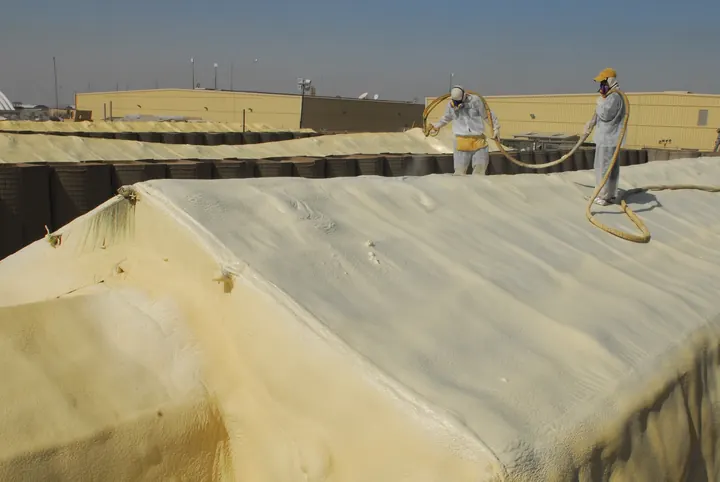
In 2008 and 2009, after tests in 2007, the U.S. Army sprayed about two inches of polyurethane foam over tents and temporary buildings in Iraq and Afghanistan to cut the fuel its generators burned for air conditioning, and the convoys that hauled it. By late 2008 about 900 structures, 3.8 million square feet, had been foamed in Iraq. Army tests at Fort Benning found foamed tents needed 75 to 90 percent less power. It was the same kind of spray foam used on buildings at home.
Key points
- The goal was fewer fuel convoys. The program "was initiated as a means of reducing the number of convoys delivering fuel to the Forward Operating Bases."
- The Government Accountability Office counted about 900 temporary structures, 3.8 million square feet, foamed at 10 forward locations in Iraq.
- Insulated tents at Fort Benning "required 75 to 90 percent less power than non-insulated tents" and used half the climate control units.
- The Army reported a $95 million contract to foam up to 9 million square feet in Iraq, a $29 million contract in Afghanistan, and a payback of 26 days in fuel.
- The lesson for buildings: an inspector general later found many foam-insulated buildings for the Afghan army lacked the thermal barrier the building code requires.
The problem: air conditioning in a war zone
In Iraq and Afghanistan, forward operating bases ran on generators, and generators run on fuel that had to be trucked in. Much of that fuel went to air conditioning tents and plywood huts in summer heat. Every truck on the road was a target.
Air Force Chief Master Sgt. Joe Cullen, of the division engineer team at Contingency Operating Base Basra, described the heat load to DVIDS, the military's news service: "I've seen tent surfaces get over 130 degrees [Fahrenheit] without insulation… Once insulated, that temperature can drop below 80 degrees."
The fix the Army chose was spray polyurethane foam, applied to the outside of the structures.

What they sprayed
Crews sprayed about two inches of polyurethane foam over tents and temporary buildings, the same two-component chemistry used on houses and pole barns: two liquids mixed at the gun, expanding and curing in seconds into one continuous shell.
One application did three things a tent can't do on its own:
- Insulation. Two inches of foam turned fabric into an insulated shell.
- Air sealing. Tent seams, flaps and fabric leak conditioned air constantly; a continuous foam layer closed them.
- A barrier to solar heat. The sun-baked outer surface stopped passing its heat straight through to the inside.
What it saved
| Measure | Result | Source |
|---|---|---|
| Structures foamed in Iraq by late 2008 | About 900 (3.8 million sq ft) at 10 locations | GAO-09-300 (2009) |
| Power, insulated vs. uninsulated tents, Fort Benning | 75 to 90% less | GAO-09-300 |
| Climate control units needed | Half | GAO-09-300 |
| Central Command's estimate of energy cut | About 50% | GAO-09-300 |
| Power reduction cited by the Army, from a GAO report | 40 to 75% | U.S. Army, May 2009 |
| Payback in fuel | 26 days | U.S. Army, May 2009 |
The Army described a $95 million contract to foam up to nine million square feet of building space in Iraq, about 60 percent complete by May 2009, and a $29 million contract for Afghanistan. The GAO noted that the Iraq contract it reviewed was terminated before completion, effective December 16, 2008, and that the military had not yet set metrics to measure the savings systematically, so the percentages above are test results and estimates, not audited totals.
The fire lesson
Spray foam is a foam plastic, and the building code requires foam plastic to be separated from occupied space by a thermal barrier, typically half-inch gypsum board. In 2013 and 2014, the Special Inspector General for Afghanistan Reconstruction reviewed polyurethane-foam-insulated K-Span buildings built for the Afghan army. It found many lacked a thermal barrier that could be validated to code, that the requirement had been left out of the specifications in 31 of 58 contracts, and that 1,600 of nearly 2,000 buildings in the $1.57 billion program did not meet International Building Code standards.
The foam did its thermal job; the missing barrier was a specification failure. It is the same rule every spray foam job in a house, shop or barn follows. Our article on thermal vs ignition barriers explains which one a space needs, and is spray foam flammable? covers the fire ratings.
What it means for a building at home
The physics in a desert tent is the physics in a steel building in a Western PA summer: a thin skin heated by the sun, seams that leak, and equipment working hard to keep up. A continuous closed-cell layer insulates, air-seals and keeps the inside face of the steel near room temperature, which is also what stops the winter dripping in pole barns (see why your pole barn roof drips).
The rockets that carry NASA's astronauts use the same family of foam at −423°F; see spray foam on rockets. The Army's tents show it working at the other end of the thermometer.
Savings vary. Find out why in the seller's fact sheet on R-values. Higher R-values mean greater insulating power.
Have a metal building, shop or barn that bakes in summer and drips in winter? Price My Project or call (814) 208-3478.
FAQ
Did the Army really spray foam on tents?
Yes. The GAO reported about 900 tents and temporary structures, 3.8 million square feet, foamed at 10 locations in Iraq by late 2008, and the Army contracted for more in Iraq and Afghanistan.
How much did foaming the tents save?
Fort Benning tests found insulated tents needed 75 to 90 percent less power; Central Command estimated about a 50 percent energy cut in the field, and the Army reported a 26-day payback in fuel.
Was the tent foam the same as house spray foam?
It was the same kind of material: two-component spray polyurethane foam, about two inches thick, sprayed on site.
Sources
- GAO-09-300: DOD Needs to Increase Attention on Fuel Demand Management at Forward-Deployed Locations (February 2009)
- Army saves fuel and lives by bringing new life to an old technology, U.S. Army (May 7, 2009)
- Foam insulation at Contingency Operating Base Basra, DVIDS (May 25, 2009)
- Ammerman, spray foam insulation of military structures, Interface (RCI), September 2010
- SIGAR Alert Letter 13-3: K-Span buildings and thermal barriers (April 4, 2013)
- SIGAR 14-77-SP: review of ANA facilities and fire safety