
The storm
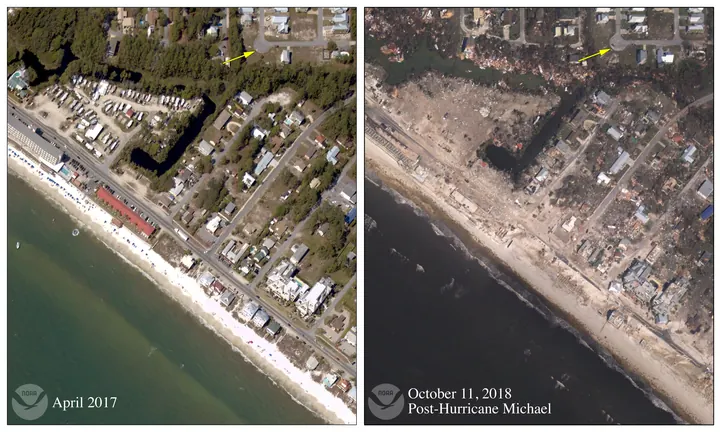
Hurricane Michael made landfall near Mexico Beach and Tyndall Air Force Base in the Florida Panhandle early in the afternoon of October 10, 2018. The National Hurricane Center's final report puts its landfall intensity at 140 knots (about 160 mph), Category 5, with a central pressure of 919 millibars, the third lowest on record for a hurricane hitting the United States, behind only the 1935 Labor Day hurricane and Camille in 1969.
The water did as much as the wind. The report estimates storm surge of 9 to 14 feet above ground along that stretch of coast, "with the highest inundation occurring in Mexico Beach," plus "significant wave activity in addition to the surge." Its count for the town: "1,584 buildings out of 1,692 in the town were reported damaged, with 809 of those reported destroyed." Michael caused 16 direct deaths and about $25 billion in damage in the United States.

The house that stood
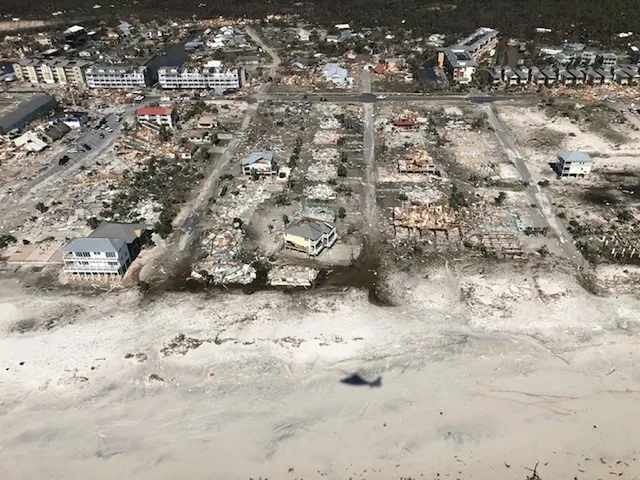
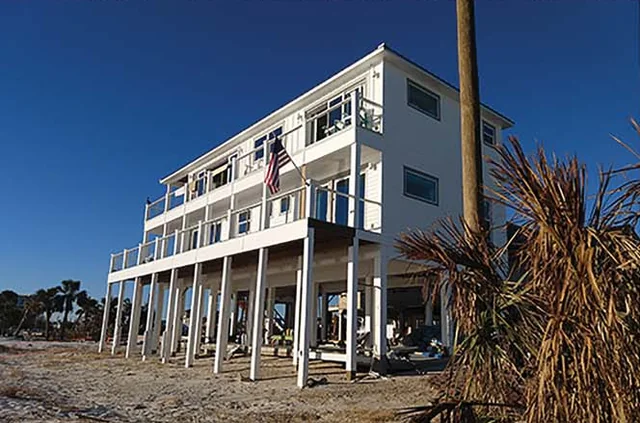
The Sand Palace belongs to Russell King, an attorney, and his nephew Dr. Lebron Lackey, a radiologist, both from Tennessee. Their families use it as a vacation home and rent it out. They built it in 2017 with Southeastern Consulting Engineers of Wewahitchka, Florida, as structural engineers, and finished it in April 2018, six months before Michael.
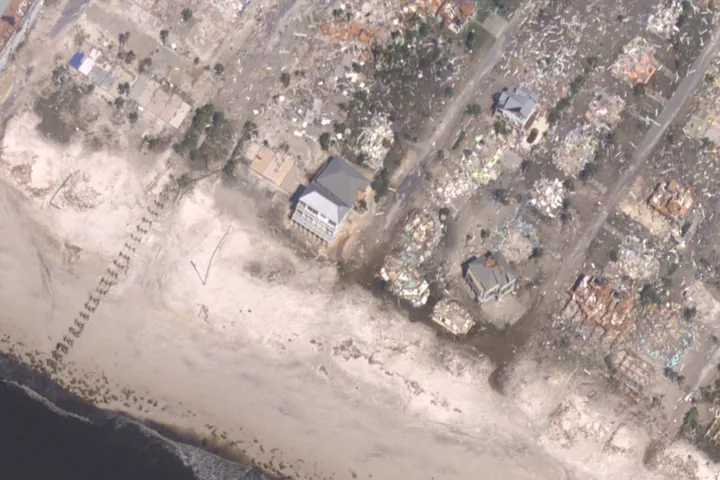
After the storm, The New York Times found it "the last surviving beachfront house on his block." The duplexes next door were wiped out, and three homes across the street were leveled to their slabs. "We wanted to build it for the big one," Lackey told the paper. "We just never knew we'd find the big one so fast."
How it was built: one part for each load
The owners told STRUCTURE magazine they went through the house element by element, from the foundation up, and asked what would survive "the Big One." Their engineers' answers, and what each part was for:
| Load | What the Sand Palace used | Source |
|---|---|---|
| Storm surge and waves | Living floors raised on 12-inch precast, prestressed concrete piles, 40 ft long and about 28 ft into the ground; ground level enclosed with breakaway walls | STRUCTURE; ICF Builder |
| Scour around the foundation | Longer piles, which the owners say "better protected against scour for a small cost" | STRUCTURE |
| Wind on the walls, flying debris | Insulated concrete form (ICF) walls with a 7-inch concrete core, #5 rebar at 18 in. each way; the engineers told the owners they would withstand 235 to 240 mph | STRUCTURE |
| Wind uplift on the roof | Hip roof, eaves cut to about 12 in. with enclosed soffits, trusses secured to the concrete walls with hurricane tie-downs, 6 in. of closed-cell spray foam at the roof | STRUCTURE; Spray Foam Magazine |
| Windows and doors | Custom units to Miami-Dade's 140 mph, 4-pound-projectile criteria, laminated glass, fewer and smaller windows (concrete in place of some) | STRUCTURE; Trosifol case study; CNN |
The height mattered as much as the strength. An engineering survey of Mexico Beach published in 2020 measured the lowest framing member of the Sand Palace at 20.7 feet above the NAVD88 datum, which "almost exactly matched the largest measured wave elevation" at the nearby pier. The biggest wave crests "came close to or barely touched" the house.
The building code set the floor, not the target. The engineers said the code wind pressures for the house were "based on a 140 mph wind speed," with a roof uplift pressure of 30 psf on an allowable-stress basis (a figure for the roof as a whole, not comparable with the edge-zone numbers in our companion case study). The owners wanted the house to last "several generations, say 100 years or so."
Where the spray foam was
Spray Foam Magazine's 2019 account, which quotes the owners, gives the most detail:
- Roof: "Above the top floor, six inches of closed-cell foam insulated and solidified the roof."
- Ground floor and garage: closed-cell foam, five to six inches, "chosen ... due to its rigidity."
- Between the middle and top floors: three to four inches of open-cell foam, for sound.
Lackey's own words: "I think spray foam did a great job of not only insulating our home, but also unifying and solidifying the roof!" The magazine was careful in its own caption: the adhesion of the foam and the small soffits "might be the reason" the wind did not pry the roof off.
What closed-cell foam adds to a roof
Lab tests have measured what closed-cell foam does for roof sheathing in general. In University of Florida uplift tests in 2007, sponsored by a foam maker, roof sheathing panels bonded with closed-cell foam sprayed from below, with the fasteners removed from the interior framing, resisted 2.6 times the uplift of nailed-only panels, an average of 196 psf. The foam bonds along the whole joint between the deck and each truss or rafter, where nails grip at points. Our spray foam and hurricanes article covers those tests and the follow-up on roof leaks.
For a sense of scale: the house's code pressures were based on a 140 mph wind speed, which in the code is a 3-second gust. Michael's landfall intensity was estimated at 160 mph sustained over a full minute, over a small area near the coast; a wind model put peak gusts in the neighborhoods just east of Mexico Beach at about 152 mph, above the roughly 132 mph design speed there. A roof deck that keeps its sheathing keeps its rain out and its walls braced at the top. The roof came through with no recorded damage. How much of that is owed to the foam, the tie-downs, the hip shape, the small eaves, the roof's extra design margin or the windows that kept the wind out of the house, no one measured; it had all of them. Lackey credits the windows: "Our home survived because of those windows." Our companion case study runs the numbers: Hurricane Michael's wind and surge loads, and where closed-cell foam fits.
Two cautions keep this honest:
- Neither the house's engineers nor the survey team mention the foam. In STRUCTURE magazine, the owners and their structural engineers walk through the piles, the walls, the windows, the roof shape and the tie-downs. The 2020 survey credits elevation, foundations, connections and "high quality roof, window, and framing details." The foam's role comes from the owner and the spray foam trade press.
- The ICF walls' foam is not spray foam. Insulated concrete forms are blocks of rigid foam board that stay in place as insulation after the concrete is poured. The spray foam was at the roof and floors.
What it lost
The most complete record comes from the 2020 survey by a team of coastal and structural engineers (Kennedy et al.), who called the Sand Palace "the most impressive structural survival" in Mexico Beach. Its damage list: utilities and local HVAC destroyed; the exterior staircase and the lower story's breakaway walls and interior destroyed; a cracked window on the top floor; one top-floor ceiling outlet popped out by the pressure difference between the house and the attic; damage to the parking slab and pavers; minor water intrusion; and one porch ceiling damaged. "No roof damage was recorded."
Other accounts add detail, and differ on how much water got in:
- Breakaway level and stairs: gone, by design. The stairs were found "a block or two from the home" and reattached. Where the ground slab did not break away cleanly, it "contacted the piers, producing some cracking," the owners told STRUCTURE.
- Windows: debris hit three windows. The outer panes shattered; the laminated inner panes kept the wind and rain out, Lackey told the glass interlayer maker.
- Water: The New York Times reported "only a little water damage and one cracked shower window." The house's own Facebook page, as reported by CNN and WeatherNation, described more: windows gone in one bedroom, one of the heating and air units gone, all the utilities to redo, and serious water and wind damage inside the ground and middle floors.
After the storm the owners added carbon-fiber wraps to the columns and ordered $20,000 of stainless steel supports and ties.
What it cost
The owners put the premium at 15 to 20% per square foot over an equivalent existing building; their architect told The New York Times that building this way "roughly doubles the cost per square foot." Public records showed a tax-assessed value of $400,000. The owners said the ICF walls cost little more because the added material was offset by lower labor, and that lower insurance and utility costs would pay back the extra in six to eight years.
Savings vary. Find out why in the seller's fact sheet on R-values. Higher R-values mean greater insulating power.
What it means for a house in Western PA
Erie is not Mexico Beach, and no one should read this as "spray foam makes a house hurricane-proof." What the Sand Palace shows is a way of thinking: follow every load from the roof to the ground, and make each link stronger than the code minimum where it is cheap to do so. Closed-cell foam under a roof deck is one of those links. It bonds the sheathing to the framing, seals the deck, insulates, and tolerates water. FEMA rates closed-cell spray foam as an acceptable flood-resistant insulation; see is spray foam waterproof?
In Western PA the same layer works against straight-line wind and lake-effect storms, and in a sealed attic it has to meet the condensation rules covered in sealed attics.
Building or re-roofing and want the deck bonded and sealed? Price My Project or call (814) 208-3478.
FAQ
What is the Sand Palace?
A three-story elevated beach house at the end of 36th Street in Mexico Beach, Florida, built by Russell King and Dr. Lebron Lackey and finished in April 2018. It stayed standing when Category 5 Hurricane Michael destroyed most of the buildings around it on October 10, 2018.
Did spray foam save the Sand Palace?
It was one part of a system. The house stood on deep concrete piles with a breakaway ground level, had reinforced concrete walls, a hip roof tied to those walls and laminated impact glass. It also had six inches of closed-cell spray foam at the roof, which the owner says unified and solidified it. Neither its engineers nor the survey team that inspected it credit the foam, and no one measured each part's share.
Was the Sand Palace's roof damaged in Hurricane Michael?
No. The engineering team that surveyed Mexico Beach after the storm recorded "No roof damage" on the Sand Palace. The damage was at the ground level, to utilities and stairs, one cracked window, a porch ceiling and minor water intrusion.
How much spray foam did the Sand Palace have?
Spray Foam Magazine reported six inches of closed-cell foam at the roof, five to six inches of closed-cell at the ground floor and garage, and three to four inches of open-cell between the middle and top floors for sound.
How strong was Hurricane Michael at Mexico Beach?
The National Hurricane Center puts its landfall intensity, near Mexico Beach, at 140 knots (about 160 mph sustained over one minute), Category 5, with storm surge up to about 14 feet above ground in Mexico Beach plus waves. 809 of the town's 1,692 buildings were destroyed.
Sources
- Beven, Berg and Hagen, Tropical Cyclone Report: Hurricane Michael (AL142018), National Hurricane Center (2019)
- Kennedy et al., Hurricane Michael in the Area of Mexico Beach, Florida, J. Waterway, Port, Coastal, Ocean Eng. 146(5), 2020 (open access)
- Dal Pino, The Story of a Survivor: Sand Palace of Mexico Beach, STRUCTURE magazine (March 2019)
- Rozycki, The Sand Palace of Mexico Beach, Spray Foam Magazine (February 1, 2019)
- The house that withstood Hurricane Michael, The Week, excerpted from The New York Times (October 22, 2018)
- Mexico Beach Survivor, ICF Builder Magazine (September 2019)
- Sand Palace case study, Trosifol (Kuraray), 2019
- Levenson, This house survived Hurricane Michael, CNN (October 15, 2018)
- Local owners of beach house that survived Hurricane Michael, The Chattanoogan (December 8, 2018)
- Before and after photos show Hurricane Michael's destructive power, USGS
- Built for the big one, WeatherNation (2018)
- Prevatt et al., Hurricane Michael final report on residential damage, University of Florida for the Florida Building Commission (2019)
- Prevatt, Wind uplift performance of roof sheathing retrofitted with closed-cell spray foam, University of Florida report (October 2007)
- FEMA Technical Bulletin 2: Flood Damage-Resistant Materials Requirements (January 2025)